Mohammed and the night bus: A search for #asylum and hope

Mohammed and the night bus: A search for #asylum and hope
Mohammed's asylum application has been refused
Mohammed’s asylum application has been refused

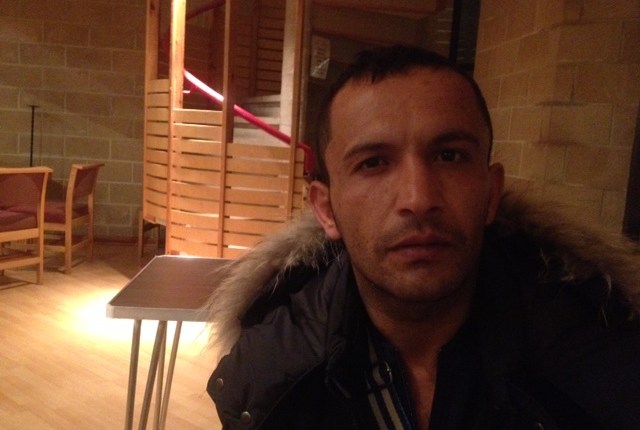
Mohammed came into this  south-east London food bank in search of help. But he feels no sense of belonging here any more – and seems disconnected from the events taking place around him.

He’s a casualty of war. He made the journey from Iraq to the UK in 2005 as a stowaway on a lorry, when he was 22 years old. His father, one of Saddam Hussein’s policemen, had been killed. The terrible trip took three or four weeks. To this day he doesn’t know what happened to the rest of his Kurdish family. They ran away to Syria and he lost track of them after that.

He’s homeless now and his asylum case has been refused. He can’t work, because he hasn’t got the immigration status to do that. Feeling that he’s come to the end of the line here in England, he wants to return to Iraq. The UK Immigration Services won’t let him, given the ongoing insurgency. Now 33, Mohammed is drinking heavily and depressed.  Some days, when he doesn’t have a drink, he starts shaking. ‘I drink too much and I’m thinking about my family.’ He’s had enough of life on the streets of London, where he sleeps when he can’t find a place on the floor of a pub. Some nights he sleeps at the train station or at a homeless shelter. On a few occasions he is allowed  to stay at a friend’s flat.

It’s cold and he doesn’t feel it would be any more dangerous in Iraq than it is here. ‘I have no home – nowhere to go. Two weeks ago I saw someone stab a person with a knife on the streets. Sometimes you see very dangerous people. Three months ago someone attacked me. He punched me in the mouth and I lost a tooth.’ His health is deteriorating. ‘I went to the GP today and told him I can’t eat properly.’ He showed me some medicine he’s been given.

In 2008 Mohammed ended up in prison for a year, followed by a 17-month spell in a detention centre because of his immigration status. Mohammed says all he had done was to ask someone for a cigarette – ‘but the man said I robbed him’.  He says that he challenged the detention at High Court and ‘won the case – I should have got £60,000, but they gave me £5,000. His girlfriend at the time stood by him while he was in detention and offered good support. But the relationship foundered.

He was sent to hospital for help to overcome his addiction to alcohol, but the detox therapy would have cost £4,800 and the Immigration Services refused to fund it. He has to check in with the Immigration Services regularly to prove he’s still in the country. Because he is destitute he can’t afford the train ticket. So every time he travels by train he runs the risk of a fine he can’t pay – followed by a trip to court and potentially another conviction for a criminal offence.

This Trussell Trust food bank was able to give Mohammed a supply of three days non-perishable food. This food is long life, and much of it needs to be cooked or heated. That’s a problem, because Mohammed normally has nowhere to cook it. He’s homeless. On the night we met he was trying hard to contact a friend to see if he could sleep at his home. I spoke to one of  the volunteers at the food bank, who said how difficult it can be to ‘signpost’ people such as Mohammed, to try to get them some help. There don’t seem to be any avenues left for him.

Mohammed told me he often sleeps on the night buses that connect the centre of London to the outer suburbs. ‘It’s not just me – there are many people who do this. People without houses.’

You don’t have to be an asylum seeker to be at risk of  homelessness in the UK. A recent analysis of government data by the University of St Andrews on behalf of Shelter, found that one in 8 UK households are surviving on low incomes while paying unaffordable housing costs. This is putting them under huge financial pressure, and  ‘more than one in 10 working families in England have had to sell possessions to cover their housing costs’. A two-bedroom flat in London costs up to £1,470 in rent, with many remaining empty and unlet for months because many public sector workers and pensioners just can’t afford them.

Next time you’re in London on a night bus, try looking around to work out  how many people are there because they have nowhere else to go.  But you might find that everyone is staring at you.

Many thanks to Mohammed for sharing his experiences of  life as an asylum seeker in London.


High rent, unemployment, homelessness and rehousing: The Ahmeds at the #Londonfoodbank

Sadida Ahmed at Greenwich food bank
Sadida Ahmed at Greenwich foodbank


Sadida Ahmed and her husband Malik used to have a reasonable life. Yes, they rented from a private landlord, and because this is London they paid a lot for the ‘privilege’ – £1,200 a month. But they both used to work – Malik had spent 15 years working full-time as a security guard. According to Malik, 44,  ‘everything was fine’. But now they are struggling, and they came into the Greenwich food bank pushing their two  daughters of just 17 months and six months in the pram. They became homeless when the landlord gave them notice to quit. The rent had become too high for the couple to afford. They were rehoused by Lambeth Council ‘out of borough’, so they ended up living in a council property  in the Royal Borough of Greenwich.

Before the family moved in they say they were told that the council property was furnished – but it turned out to be unfurnished. So one of the babies doesn’t have a cot and the couple are sleeping (and sitting) on an old mattress in the living room. They do have a cooker – but no washing machine.

Malik is looking for work and Sadida, 28, is four months pregnant. What little money they have – Malik’s Job seeker’s Allowance, child tax credit and child benefit – doesn’t go very far. Having small children is very expensive at the best of times. Money needs to be found for nappies, formula milk and baby clothes, on top of the usual household bills.

Here Malik describes the family’s difficult circumstances.

He says: ‘I have £113 a week and I have to pay bills and pay for the babies’  food. I’m really struggling at the moment and I don’t know what to do and that’s why I’m here. I ran out of food. I’m not getting enough money to look after my family at the moment. I’m keen for work and looking for a job. When a job comes I will be fine, but at the moment it’s really hard.  I have two small babies of six months and 17 months, and my missus she’s pregnant too. Shes 14 weeks plus. It’s really hard to cope with.’

Harpinder Singh, a local councillor in Woolwich happened to be at the food bank, and met the couple. Malik has promised to get in touch with him. Harpinder, who has spent some time in this food bank recently, says that the situations he encounters might be expected ‘in the Far East or Africa, but we shouldn’t see them here’. He says he recently heard of a young family with no electricity or gas at home – ‘and then it becomes a safeguarding issue as they can’t cook food’. The next step in that case was to refer the issue to staff at the council, for an immediate response’.

He believes that the Royal Borough of Greenwich ‘has a willingness to help’. He says that before the most significant changes to the benefits system kicked in, ‘we identified people who were most likely to be affected by the changes – we identified them early and tried to help them get back into work’. He said that ‘to his knowledge we have not had to move people out of borough – not like in Tower Hamlets or Westminster’. He added: ‘It’s about using your resources – we’ve done well (at helping the vulnerable on the limited resources we have.’

Councillor Singh believes that its going to get even harder to help the most needy.  The Local Government Association has warned that support for vulnerable people in crisis will either have to be scaled back or scrapped completely in almost three-quarters of council areas from next April when government stops funding for Local Welfare Assistance schemes. A survey of local authorities suggests ‘councils will hugely struggle to maintain current levels of help for vulnerable people when government scraps the £347 million Local Welfare Assistance fund next year’, according to the LGA, and ‘the ending of government funding for councils’ emergency support schemes comes on top of a 40 per cent reduction in local government funding over the course of this Parliament’.

The Local Welfare Assistance fund was introduced in 2013 to replace government-provided crisis loans, with each local authority area allocated money from the £347 million total. Government’s local government finance settlement published last December revealed that funding would not be continued from 2015, despite no consultation being held on the scheme’s future.

Meanwhile, in the increasingly surreal world of London housing, London Mayor Boris Johnson is said to be about to approve plans today for ‘affordable housing’ flats that could cost tenants up to £2,800 a month to rent. He’s not fighting a one-man crusade either. According to a letter in the Guardian yesterday from chairs of the former crown estate residents’ associations, Peabody, a charity whose founding purpose is to improve the conditions of the poor and needy in London, is ‘also advertising homes it bought from the crown estate in 2011 at ‘affordable’ rents that no key worker can afford’. The former chairs have called on Peabody to ‘scrap this ludicrous rent model and honour its commitments to us and to its founding principles’.

When Malik finds a job, what are the chances that he can move his young family into a home in a location of their choice, at a level of rent that still enables them to lead a decent life?

Is that too much to ask?


Giving and Receiving at the #Londonfoodbank


Greenwich food bank volunteer Debbie Angel

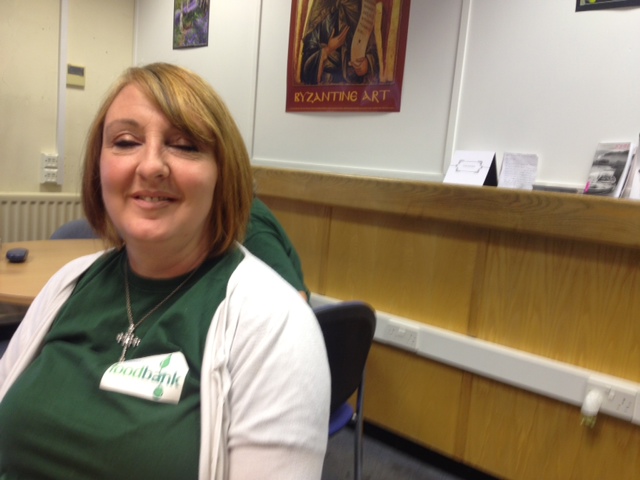
This is the story of food bank volunteer Debbie Angel and her feelings about  both the work that she does and the clients who come to the food banks in this corner of  London. Debbie (pictured left) greets the people who come in here, helps them to feel more at ease, and provides a listening ear as well as a crisis package of food to those  in need.

They’re coming through her doors in increasing numbers. London  may be the best city in the world to move to for work,  according to a survey of over 200,000 people in 189 countries compiled by The Boston Consulting Group, recruiters The Network, and totaljobs.com.  But for many of  London’s existing residents – mainly those who are out of work, or on low incomes, or disabled and in ill-health – the city doesn’t seem nearly as attractive as this. It doesn’t seem quite the gleaming metropolis to the clients who arrive to see Debbie and the other volunteers each week.

When you take a closer look there’s a massive problem here and throughout the UK. The food banks here in the Royal Borough of Greenwich and across the UK come under the franchise of the Trussell Trust Network and the Trussell Trust’s statistics on food bank use are truly shocking. In 2013-14 913,138 people were given three days of emergency food and support, and the primary referral causes were benefit delays (31%) and low income (20%).  In 2012-13 the figure was 346,992. But as the chairman of the Trussell Trust Chris Mould says – these figures are merely the ‘tip of the iceberg’.  The charity has more than 420 food banks, but represents well under half of the total number of emergency food suppliers in the UK.  A  January 2014 report by Dr Eoin Clarke put the Trussell’s Trust’s share of the food bank sector at 43%.

When they reach the food banks here, people are desperate and at the end of a road. They can’t feed themselves or any dependents they may have.

If that happened to you, how would you feel about it? Maybe you’d be angry, depressed, frustrated or powerless? Would you feel somewhat bitter and resentful of  others in this rich capital that people from all over the world seem to want to move to for work?

Well here’s the thing.

While people do want to share their experiences and explain the life circumstances that have led them here, people don’t tend to leave the food bank steeped in those emotions.

The accounts that people often share of their lives are ‘very heavy and very difficult’, says Debbie. But she believes that the common thread linking together the people she meets is gratitude and a desire to give something back to the organisation that has helped them through one of the hardest times in their lives. She says: ‘They are so grateful that we care about them. It’s the fact that you’ve listened to them. They encourage me as much as I encourage them. Giving them the food is the least of what happens. That’s the hardest thing for them to take away. Giving them some loving care and kindness and being here and hearing them speak is the important bit. They want to give things back when they are able.’

She adds: ‘This is not a one-sided thing – I love speaking to people here.’

I see people leaving with their heads held higher than when they came in, thanks to people such as Debbie.