Sarah, a single woman of 28 and a law graduate, came in on Friday and kindly shared her account of why she needed help. Before I pass on her story I’d like to remind readers that I don’t speak for those who run this London food bank, although they’ve allowed me to interview their clients. Any opinions expressed on this site from time to time are my own. I don’t represent the food banks in the borough of Greenwich. Neither do I represent the views of the Trussell Trust, which partners with churches in this area to run the food banks.
Sarah (not her real name) must have thought her life was on a more even keel when she finally worked up the courage to escape the violence in her family home. She had moved back in again in 2008 when she struggled to find a job after leaving university. It wasn’t a good time to be graduating. The economy had just tanked. She was also battling a serious mental health issue – borderline personality disorder (BPD). Once home, she says she found herself ‘scapegoated’ for not having a job and once again the target of a relative’s abuse and violence.
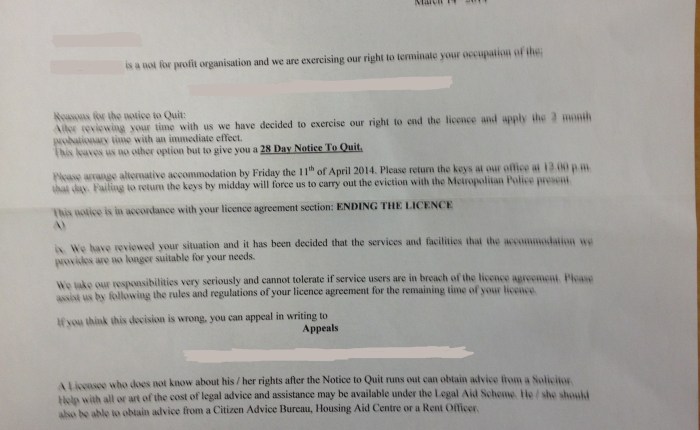
Now she faces the reality of being evicted (see letter below) from the shared house run by a housing trust in Greenwich – the borough she came to for help.

Making the decision to flee her home at the end of January was a difficult one, as she had to leave two younger siblings behind. While she did bring in the police to have her relative arrested, after careful deliberation she decided against bringing charges, because she believed there would be ‘some fall-out’. It would now seem as if this intelligent, articulate and vulnerable young woman is being treated with a distressing lack of respect by those who are ‘dealing’ with her.
Initially she went to her own borough some distance away for help with rehousing, but she says they ‘put me in a half way house for the weekend, with no money and no food, sharing with a guy who had just come out of prison for armed robbery – despite me having just come away from a situation of domestic violence’. For safety, she fled to our borough, with the help of some of her wider family network (whom she can’t stay with as it would bring her back within the orbit of the relative she’s fled). After five days of pleading with this council for help, she was registered as homeless and says she was placed by the council in a shared hostel run by a housing trust that also owns a number of properties in the area.
Sarah says she complained to the housing trust, which I’m not naming to preserve her anonymity, about regular absences of heating and hot water. She also complained about the intrusive room inspections at odd times that she says were carried out. ‘Every time they want to annoy us, they just say it’s time for a room inspection. I feel that I’m being ambushed all the time.’ She says those running the hostel charge each resident – Sarah shares the house with three other people – a £15 a week service charge on top of the money they receive from the council. Sarah says the council are paying for her housing benefit, council tax and heating. She says that there’s a meter for heating and hot water, but that the staff ‘don’t put enough money on the card’, leaving them short at least one day a week. ‘Even when we do run out of heat, there are still signs around saying that if we have an electric heater it will be taken away.’
She says she’s also heard that each resident is supposed to be getting £3 per head for breakfast, but hasn’t received any of that. This week she says it was the combination of the service charge and a broken fridge that took a couple of days to replace that led her to the food bank (she got the voucher from the job centre). Although she gets on well with one of the men (aged 57) she shares with, it doesn’t seem at all appropriate that she should be in mixed sex accommodation at this stage given the issues that led to her being declared homeless. Where’s the safeguarding?
Now the people who run the housing trust have given her a 28-day notice to quit. In the letter they say: ‘We have reviewed your situation, and it has been decided that the services and facilities that we provide are no longer suitable for your needs’. She has been told in writing to move out by 11 April. The letter does not give any reasons why the hostel is thought to be unsuitable for Sarah – or why she’s deemed unsuitable for the hostel.
She says she’s been told verbally it’s because she’s ‘complaining too much’. According to Sarah, they have other houses in the area, ‘where drug taking and drinking are going on, and they turn a blind eye’.
Sarah has a female case worker at the council, whom she says tells her that she’s ‘lucky not to be out on the streets’. At this stage Sarah doesn’t know where to go or who to talk to, and feels that she’s being treated in a contemptuous and degrading way. ‘I know that when you are on benefits people talk to you like crap, but I feel really belittled when she talks to me like that. She knows I have mental health issues, and I know it’s not just me she talks to like that.’
The housing trust says on the eviction letter that it is a not for profit company, limited by guarantee, The letter also displays a registered charity number. Sarah says her understanding is that because she has ‘a licence agreement rather than a tenancy agreement, they don’t need a court order to evict me’.
At noon yesterday I asked both the council and the housing trust to address the concerns raised by Sarah, asking them to respond by this morning. I’ve also asked the housing trust to tell me why she’s being evicted. As yet, I’ve heard nothing at all from the housing trust. The council have told me that they would update me today about ‘what we may be able to come back on, and when’. I’m still waiting, and will of course pass on anything I receive.
What Sarah really wants is to get well enough to get a job. She did some volunteering in the autumn, for which she received some expenses. But sadly that messed up her Employment and Support Allowance (ESA)payments. Two weeks before Christmas her benefits were suspended, and she was told she couldn’t contact any of the ‘decision makers’. Wait, and we will get in touch with you when we’re ready, was the message.
She recognises that ‘certain things that happened are messing me up long term’. She says she would like to take programmes in mindfulness and dialectical behavioural therapy, which has been recommended as an excellent approach for BPD. This may be available on the NHS, but there is of course a waiting list. The good news is that her old mental health trust has a recovery team, who have said they will try to help.
The last thing she needed was the stressful and destabilising experience she has described since running away from a terrible home situation. All she wants – and surely deserves – is some stability and a measure of contentment after many years of hell.
Debt also played a corrosive, polluting role in Sarah’s story. I was among 600 people who attended a landmark free conference at the weekend organised by the Jubilee Debt Campaign Life Before Debt’s extraordinary range of speakers forensically examined debt from all angles, including the morality of debt repayment in the currentl neoliberal economy. It asked: ‘Is it a moral absolute: more important than feeding families, teaching children and providing healthcare and basic social protections?’ This conference made me feel as if I was waking up from a long sleep. It looked at how, six years on from the crash, ‘debt is at the centre of a broken economic system that is hurting people everywhere’.
Sarah says her family was ‘bound together’ by debt – and debt contributed to the family’s implosion. From the outside all would have looked good to the neighbours. Large house, nice cars in the drive. There had been wealth, and there is still work for some in the family. But the money has been ‘squandered completely’, says Sarah. The house is falling apart and the family had to cut back on food and heating. The house went on the market for a while, and Sarah says she felt humiliated when would-be buyers saw how they were living.
The conference talked about the power imbalances between debtors and creditors, and the toxic shame felt by those in debt, who hide the reality of their situation. Campaigns Officer of the Children’s Society Katie Curtis says that debt issues are being felt around the household, causing ‘a mental health time bomb, ready to go off’.
Alinah Azadeh, an interdisciplinary artist, told the conference about creative debt resistance project Burning the Books – a chance for people to add their own stories about debt to the Book of Debts. There is ‘no debt without a story, from private loans, unpaid corporate taxes, unrequited love and lost lives, to political repression, family feuds and missed opportunities….’.
Debt is many things, says Alinah: ‘Debt as freedom, obscenity, excess, a form of violence, a dead end…Debt as crime, fear, lament, a sign of poverty and wealth. Burn the records, redistribute the land, take control.’ The Book of Debts will be burned in a symbolic act of debt relief in Brighton on 22 May.


 Ann McGauran