Mark unravels after sanctions: “The process left me feeling suicidal.”

Mark unravels after sanctions: “The process left me feeling suicidal.”
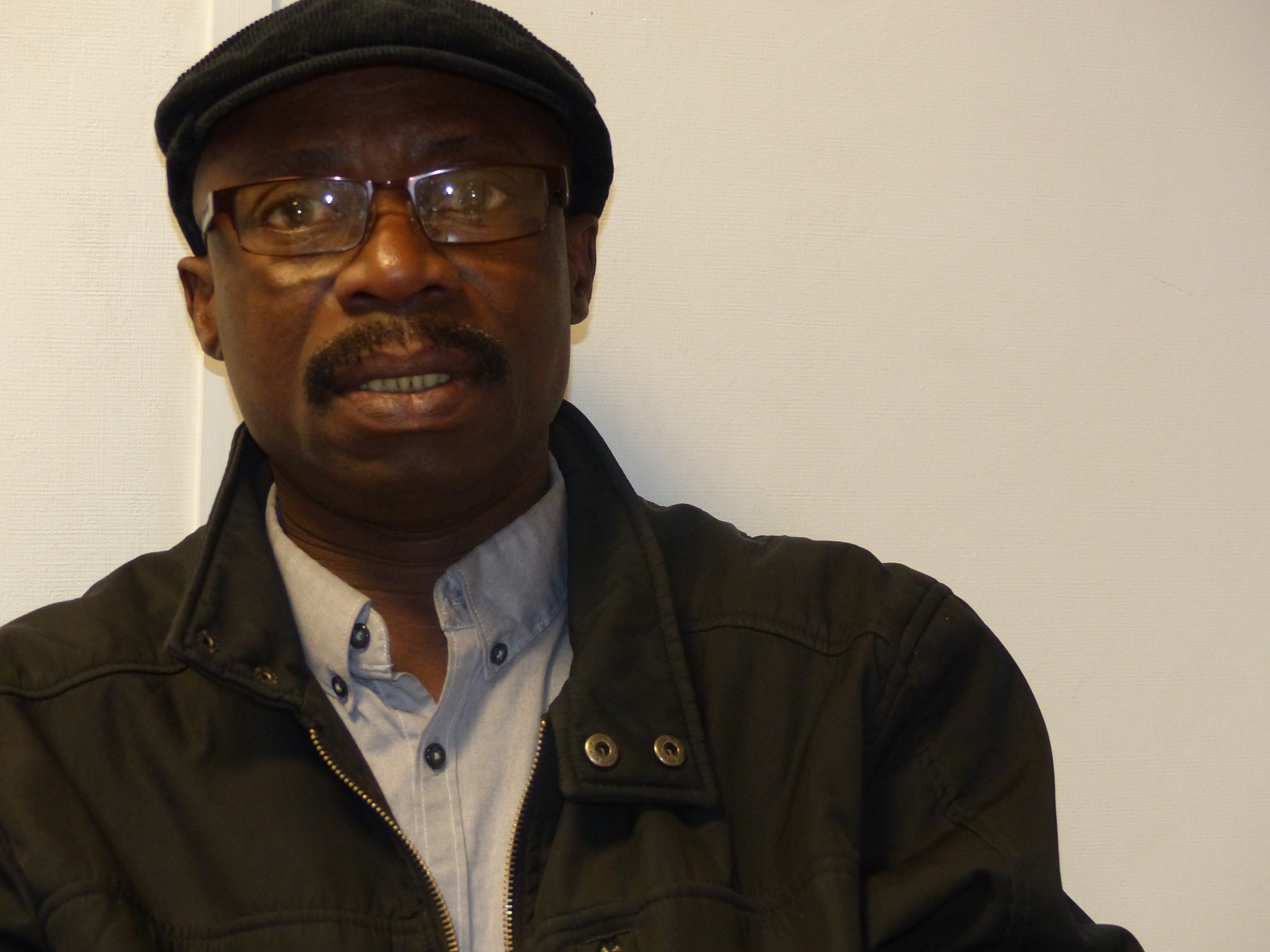
Mark Bothwell is now recovering from his sanctions trauma

According to Vox Political  and the Disability News Service, the UK government seems to have become the first country to face a high-level inquiry by the United Nation’s Committee on the Rights of Persons With Disabilities (CRPD). The committee has the power to do this if it receives what it calls “reliable information of grave or systemic violations” of the rights of disabled people by a country signed up to the UN Convention on the Rights of Persons with Disabilities (UNCRPD) and its optional protocol.

The committee conducts its investigations “confidentially”, so it has refused to confirm or deny that the UK is being investigated. Disability News Service has reported that CRPD appeared to have put off its public examination of the UK’s approach to implementing the disability convention until after next year’s general election. According to Vox Political, it now appears that the committee “may have taken this decision because it had launched the much more serious – and so far unprecedented – inquiry into the UK’s violation of disabled people’s rights”.

Surely here in the UK we wouldn’t abuse disabled people? Could that really happen in London, for example – a sophisticated and rich world capital, recently revealed by an article in Forbes as the world’s “most influential global city”. London was ranked first in the world on the Z/Yen Group’s 2013 Global Financial Centres Index. The article admiringly states that “its location outside the United States and the eurozone keeps it away from unfriendly regulators”, and it’s a “preferred domicile for the global rich”. Given all that serendipity and wealth, the world’s most influential city must also be in a position to influence things to ensure its residents don’t starve?

The benefits of London’s position as a welcoming home for the world’s rich don’t appear to be improving matters for the clients at the food bank frontline in London – or nationally for that matter. Greenwich food bank (which is currently operating from seven locations across the borough) has seen visitors increasing from 776 to 5025 in the past year. In nearby Lewisham, the figure rose from 623 to 3895. Mananger of the Greenwich food banks Alan Robinson tracks the increase he’s seen to welfare changes dating from April 2013, including the bedroom tax and welfare cap.

A few days ago I caught up with long-standing Greenwich food bank client Mark Bothwell, who has depression and whose shoulder injury had developed into a chronic problem. I’ve interviewed Mark many times, and he’s a warm, intelligent and engaging young man of 29. His experiences must make him one of those said to be experiencing diabolical treatment – those “grave violations” – at the hands of the Department for Work and Pensions (DWP) over many, many months. Mark told me that by July he was so distraught that he felt  suicidal.

Despite having already waited  for a prolonged period on jobseeker’s allowance (JSA) while believing that his claim for employment and support allowance (ESA) was being assessed, Mark was not only told that his ESA paperwork had been lost, but that he had been sanctioned – twice – for supposedly failing turn up for jobseeker advice appointments with Greenwich Local Labour and Business (GLLaB). He was told that he’d received the first sanction stopping his JSA at the end of May and that they had written to him telling him about the appointment. He says he did not receive any such letter. He began an appeals process with the help of Greenwich borough’s Welfare Rights Service. While he was told that the appeal for this sanction was being allowed, he was informed “in the same sentence that I was not going to get any money, because there was a second sanction for the same period of time for another missed appointment that I didn’t know about”. He says they told him they had sent another letter – “but I didn’t receive them”.

When the initial sanction was imposed, Mark was plunged into a nightmare of making multiple phone calls to different people in an attempt to get some help. It took two weeks to get a DWP hardship payment (about 40 per cent of normal JSA) through, and this was not enough to cover his bills – ” I had to borrow money”. He had to make multiple calls to the JSA enquiry line on his landline. He was told that if he wanted to talk to a “decision maker” he would have to call the enquiry line and leave a message for the “decision maker”, who would then call him back. He says that “on almost every phone call he was told something different”.

He added: “From about the beginning of June until mid-July I made about 60 phone calls trying to sort out the appeals and the (lost) ESA (claim). I had to resubmit the application for ESA because they said they lost it. On almost every phone call I’d be told something different. That process left me feeling suicidal. They were telling me a different thing every single time. They would tell me it (my money) would be a week, then I phoned up and they said no they shouldn’t have told you that. Then with the last phone call the woman said, no it doesn’t happen like that, it takes another two weeks. She was so rude I just hung up and collapsed on the floor. Tears were running down my face. I actually said out loud the word suicide to my flatmate, to my family and to complete strangers. I hit rock bottom around July 10-12.”

About a week later, Mark was told that he would get ESA, and that it would be backdated from the end of May. He is now receiving £144.80 a fortnight. The regular money is “helping a lot” and he says he can now buy food items such as fresh meat. He’s certainly looking brighter and stronger now.  Mark shares a home with a disabled flatmate and friend. This person has been told he’ll be getting a Personal Independence Payment (PIP) for help with some of the extra costs of being disabled. With the PIP finally in place, Mark has at last been able to fill in the application form for Carer’s Allowance in relation to the help he gives his friend. He’s also finally getting better help for his depression, and has been able to come off his Tramadol medication, which was beginning to badly affect his short-term memory.

Finally, after this atrocious wait and a host of adverse developments, Mark is starting to get the benefits he’s entitled to. But why did the state allow him to languish for such a long time waiting to move from JSA to ESA, and without Carer’s Allowance? Mark began experiencing problems with his shoulder last October, and in May, I reported that he’d already been waiting months for his ESA claim to be processed. In respect of his friend’s PIP application, we know that PIP claim backlogs during the first year of its introduction have caused tremendous problems for the disabled.

During his time without benefits because of the sanctions, Mark had to survive for two days without any food. As a long-standing client of Greenwich food bank, Mark has been provided with the usual three days’ supply of nutritionally-balanced non-perishable food on about a dozen occasions. Greenwich food bank is part of the Trussell Trust network of food banks. Its policy and commitment is to provide short-term help through a crisis for people who’ve been referred by a frontline professional such as a social worker or health visitor. The decision was taken not to provide another food parcel. This happened after careful discussion and review. The Trussell Trust believes that providing food aid on multiple occasions for an individual can remove an essential incentive to fix the underlying problems that drive people to the food bank in the first place.

Mark has been very appreciative of the support he’s received from the food bank over the last number of months. Very thoughtfully, once his ESA money came through he brought in a cake and a thank-you card – to the delight of the volunteers.
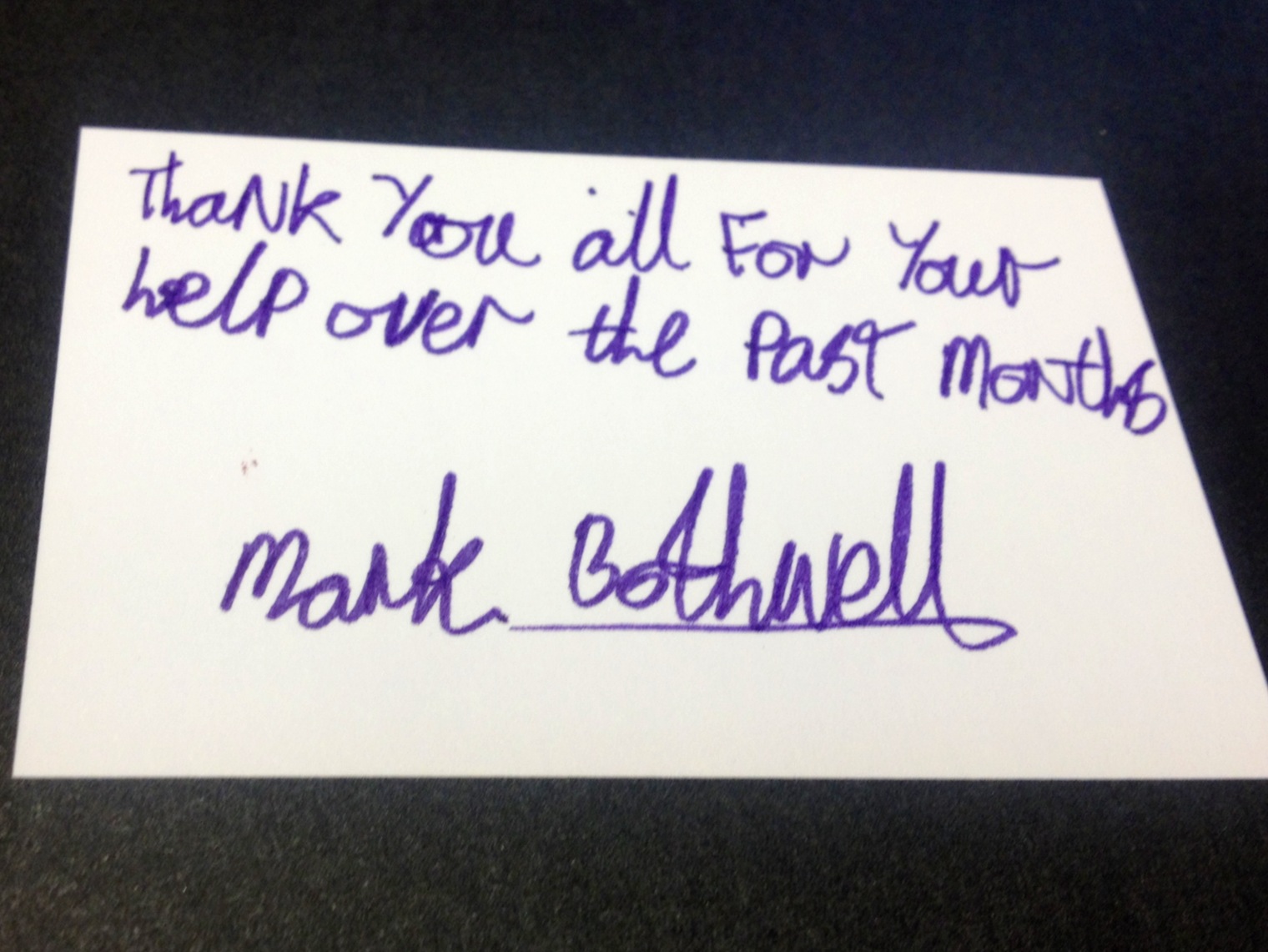
Mark shows his appreciation for the food bank's help
Mark shows his appreciation for the food bank’s help

In July, a report – Dignity and Opportunity for All: Securing the Rights of Disabled People in the Austerity Era – was published by the Just Fair consortium, which included Disabled People Against Cuts and Inclusion London. it suggests the UK had moved from being an international disability rights leader to risking becoming a “systematic violator of these same rights”. Many of the individual accounts I’ve collected here, including Mark’s, add to the evidence that the vulnerable and disabled are the subject of the gravest injustices.
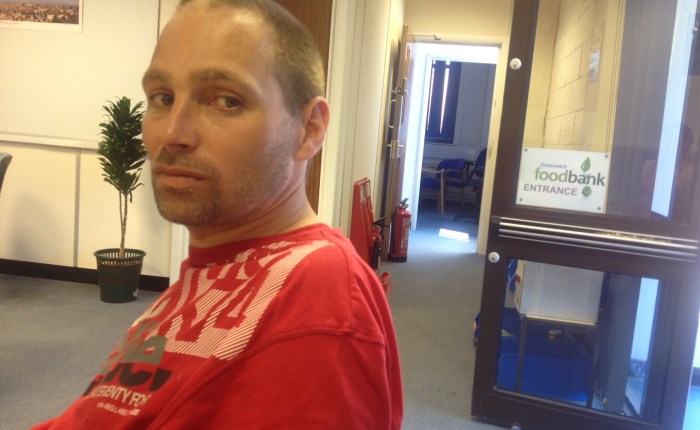
Kevin sanctioned on Work Programme and now begging for food

Kevin sanctioned on Work Programme and now begging for food
Kevin Jobbins, who's living on £7 a fortnight for food, following a benefit sanction
Kevin Jobbins, who’s living on £7 a fortnight for food, following a benefit sanction

How does it feel to be “living” on a budget for food of £3.50 a week? Kevin Jobbins is doing exactly that, but the more you think about it, the less appropriate the concept of  existence or survival seems in this context. To survive  conjures up images of Everest expeditions  – involving a set of risks voluntarily  endured  by explorers who’ve personally opted to challenge their own physical and emotional limitations.

Kevin, on the other hand, came into the Greenwich Foodbank   because  he’s  not  surviving. The Department for Work and Pensions (DWP) has failed to reinstate his benefits following a sanction in April. Kevin is 39, and is  receiving employment and support allowance (ESA). He’s waiting to go into detox treatment for drug and alcohol issues and is also on the waiting list for surgery on his feet for problems  linked to his time as a homeless person. Despite his multiple health issues, he was registered with a Seetec job club.

He was sanctioned for missing an appointment with Seetec. He says he had no option,  as he had to look after his two year old son that day. Since April his benefit rate has plunged from £202 a fortnight to £47.  He says that Seetec have told him the sanction has been lifted, but that the job centre in Woolwich says it hasn’t. His housing benefit was stopped as a result, but has now been restarted. But out of the £47 he has to pay £9 for council tax, £10 as a contribution to rent, £10 for electricity and £10 for gas. So that leaves about £3.50 for food.

The result? “I’m begging for food or nicking stuff. I got caught in Tesco. I’m also paying £10 a fortnight in court fines. This is the first time I’ve had to use a food bank. I’m angry. I don’t think I should have to beg for food.  I should have my money reinstated.  I am literally living hand to mouth.” Kevin, who’s on pain medication, adds: ‘”If I can’t nick a sandwich from Greggs I try to beg a couple of pot noodles.”

Should Kevin have been referred to the Work Programme given the extent of his health and addiction problems, and what help has it been to him? The sanction this ill man had imposed on him for not turning up to an appointment has done nothing other than to push his life further into chaos and undoubtedly towards worse health.

For whose benefit? Mike Sivier at Vox Political has flagged up how much money has been paid to Work Programme providers from when the scheme began until March 31 this year. His post links to  alittleecon, who highlights that since the programme began, 39% of  the money paid to providers – who are mainly private sector organisations – has come from the “attachment fee”. The DWP document publishing the Work Programme costs is here.  For the first year of the programme, the attachment fee was £400, the second year it was £300 and for last year £200. From July, the fee will no longer be paid.

To quote from the alittleecon post: “To date then, on this ‘paid by results programme’, the Government has paid providers £538m (out of a total of £1.372bn) just for taking people on their books and before they have helped a single person into work.” With this payment for doing nothing now ended, will we see Work Programme providers start to walk away?” Alittleecon estimates that around 1.72 million people have been attached to the Work Programme since it began, and the DWP is saying that over the same period there have been 296,000 job outcomes,  “so that means only about 17% (1 in 7) have found work lasting at least six months – not a great return for a spend of £1.4bn, particularly when you think that a lot of these people would have found work anyway”.

This system has let Kevin down badly. Kevin has been told to inform that food bank manager here if the job centre fails to confirm early this week that his benefit has been reinstated. I’ll update on this. Are more and more individuals ending up like him – vulnerable sick people sanctioned while on the Work Programme and effectively left to starve and steal to stay alive – begging on the streets for pot noodles?

Thanks to Kevin and the many people who use the food bank who’ve decided to speak to me.


London foodbank life: Surreal at times, but dangerous too

London foodbank life: Surreal at times, but dangerous too
Ben Adou hasn’t received jobseeker’s allowance since early March. He came into the foodbank hungry.

I’m pondering the brutal absurdities of day-to-day life for a growing number of the people I come across at this London Trussell Trust foodbank. Sarah (not her real name), wants a job. She’s a gentle and intelligent 28-year-old law graduate with Borderline Personality Disorder (BPD). A month ago she was nearly made homeless when the hostel told her they were going to evict her. The housing association running the hostel changed its mind at the last minute, but tragically she’s considering escort work as a possible way to clear debts, including a Wonga loan at extortionate rates. What does the future hold for her after she finally worked up the courage to escape a violent home situation? Will Mark, who’s trying to battle both depression and a debilitating shoulder injury, ever get his claim for employment and support allowance (ESA) processed? It’s been more than 10 weeks now, and he’s still no clearer about when he’ll get his money. Meanwhile his health is deteriorating fast, with other worrying symptoms now developing, which have driven him to the local hospital’s accident and emergency unit.

While they struggle on, Ben Adou (pictured above) came into the foodbank to share his story. Last week I mentioned that he brought along a foodbank voucher – his third. He couldn’t have survived without them, as he hasn’t received any jobseeker’s allowance (JSA) since March 7. This has plunged Ben – a widower of 56 whose wife died of cancer in 2012 – into a financial crisis. He claims housing benefit, has no savings and has nothing to fall back on. There is no safety net here. He came into the foodbank at what he somewhat ironically called lunchtime – hungry because he hadn’t been able to eat that morning. At least he was able to get some tea and a spare sandwich, and leave with his emergency pack of long-life food and some bread that had been donated that day. ‘You have brought me happiness by giving me food’, he said.

The problems started when Ben, who mostly works as a labourer, was offered a job through the controversial Universal Jobmatch scheme at the beginning of March. It turned out to be just two days of work, which he said had ‘completely messed up my JSA claim’. It’s also impacted on his ability to pay a contribution towards his rent, pay his council tax and to meet other household and phone bills. It has made it almost impossible for him to get to interviews. Crucially, of course, he can’t buy food. Any sort of a social life is totally out of the question, of course. With his JSA on hold, he now has no idea exactly when his benefit payments will resume. He called into the jobcentre to try to get to the bottom of things: ‘They said I was overpaid JSA during spells when I was working, and I disagree. They’ve put in writing that they know they owe me £431.60, but they’re saying that I owe them about £286.00 – and that this was a possible overpayment to me.’

The Government’s Universal Jobmatch website  – managed independently by private recruiter Monster – has come under much criticism. MP Frank Field said in a Guardian article, that it is ‘bedevilled with fraud’ and ‘out of control’.The Department for Work and Pensions (DWP) revealed in a letter to Field that more than 350,000 job adverts might breach the website’s terms and conditions , which specify that employers must advertise a real job, not use premium rate numbers, pay at least the minimum wage and not cost the applicant any money to start.

In the meantime, Universal Jobmatch keep on sending him texts calling him to jobs he can’t take up and job interviews he can’t attend – because he has absolutely no money to get there. A few weeks ago he passed two interviews for some work in central London, but couldn’t get the money together to travel up to the job. The day before he had been offered work starting yesterday in Morden, ‘but I had to say no because I couldn’t afford to travel there’. He has no money, so needs a job. He can’t get a properly paid job, because he has no money to get there. A week previously he had been called for a first interview for a commission-based job, then was offered an induction. It was only at that point that he found out he would have to use an Oyster card and put money on it himself to enable him to travel around London to sell products door-to-door. Needless to say, ‘this wasn’t explained at the team meeting’.

He explained to JobcentrePlus that he needed some money, but doesn’t seem to have been told that he could have been given money directly by them. There’s a fund for that sort of thing, you see. But no-one seems to be told about it. Every year in April, JobcentrePlus offices are given a budget to pay for Budgeting Loans.These are interest free loans for people on JSA and other benefits. Travelling expenses within the UK are included in the needs covered by such loans. This money comes out of the JobcentrePlus Social Fund budget.

Ben, like many of the people I meet, is dealing with this ghastly situation with tremendous resilience. But there’s only so long he can cope without long-term damage to his health and wellbeing. He is diabetic and he also has a heart problem. Kafkaesque doesn’t even begin to describe the ridiculous, complex hassles faced daily by a growing number of our most vulnerable citizens. This week we found out that committed campaigner and journalist Mike Sivier’s battle to get information on deceased former sickness benefits claimants released that is clearly in the public interest has been unsuccessful – so far. He wants an update on the number of sickness benefit claimants who have died, but a tribunal has upheld the Information Commissioner’s decision that his Freedom of Information request was ‘vexatious’. But the judge criticised both the information Commissioner and the DWP for the other reasons they put forward to prevent the death figures from being made public. From what seems to be emerging here in London, do we also now need to look more closely at the equivalent figures for people on JSA?