Opening the doors: Debt, domestic violence, power relations and an eviction notice

Opening the doors: Debt, domestic violence, power relations and an eviction notice

Sarah, a single woman of 28 and a law graduate, came in on Friday and kindly shared her account of why she needed help.  Before I pass on her story I’d like to remind readers that I don’t speak for those who run this London food bank, although they’ve allowed me to interview their clients. Any opinions expressed on this site from time to time are my own. I don’t represent the food banks in the borough of Greenwich. Neither do I represent the views of the Trussell Trust, which partners with churches in this area to run the food banks.

Sarah (not her real name) must have thought her life was on a more even keel when she finally worked up the courage to escape the violence in her family home. She had moved back in again in 2008 when she struggled to find a job after leaving university. It wasn’t a good time to be graduating. The economy had just tanked. She was also battling a serious mental health issue – borderline personality disorder (BPD). Once home, she says she found herself  ‘scapegoated’ for not having a job and once again the target of  a relative’s abuse and violence.

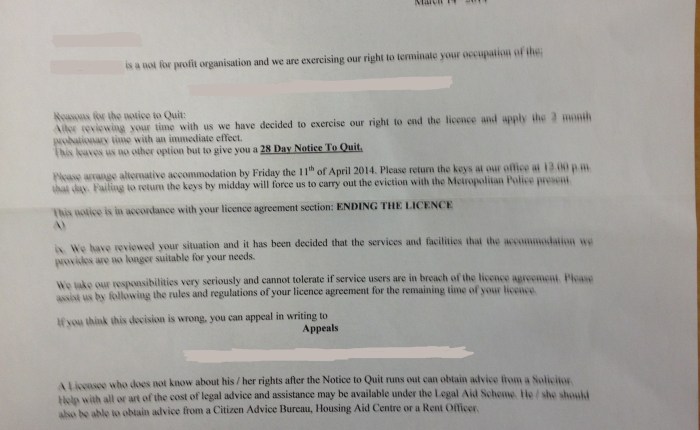
Now she faces the reality of being evicted (see letter below) from the shared house run by a housing trust in Greenwich – the borough she came to for help.

eviction - no meta

Making the decision to flee her home at the end of January was a difficult one, as she had to leave two younger siblings behind. While she did bring in the police to have her relative arrested, after careful deliberation she decided against bringing charges, because she believed there would be ‘some fall-out’. It would now seem as if this intelligent, articulate and vulnerable young woman is being treated with a distressing lack of respect by those who are ‘dealing’ with her.

Initially she went to her own borough some distance away for help with rehousing,  but she says they ‘put me in a half way house for the weekend, with no money and no food, sharing with a guy who had just come out of prison for armed robbery – despite me having just come away from a situation of domestic violence’. For safety, she fled to our borough, with the help of some of  her wider family network (whom she can’t stay with as it would bring her back within the orbit of the relative she’s fled). After five days of  pleading with this council for help, she was registered as homeless and says she was placed by the council in a shared hostel run by a housing trust that also owns a number of properties in the area.

Sarah says she complained to the housing trust, which I’m not naming to preserve her anonymity, about regular absences of heating and hot water. She also complained about the intrusive room inspections at odd times that she says were carried out. ‘Every time they want to annoy us, they just say it’s time for a room inspection. I feel that I’m being ambushed all the time.’ She says those running the hostel charge each resident – Sarah shares the house with three other people – a £15 a week service charge on top of the money they receive from the council. Sarah says the council are paying for her housing benefit, council tax and heating. She says that there’s a meter for heating and hot water, but that the staff ‘don’t put enough money on the card’, leaving them short at least one day a week. ‘Even when we do run out of heat, there are still signs around saying that if we have an electric heater it will be taken away.’

She says she’s also heard that each resident is supposed to be getting £3 per head for breakfast, but hasn’t received any of that. This week she says it was the combination of the service charge and a broken fridge that took a couple of days to replace that led her to the food bank (she got the voucher from the job centre). Although she gets on well with one of the men (aged 57) she shares with, it doesn’t seem at all appropriate that she should be in mixed sex accommodation at this stage given the issues that led to her being declared homeless. Where’s the safeguarding?

Now the people who run the housing trust have given her a 28-day notice to quit. In the letter they say: ‘We have reviewed your situation, and it has been decided that the services and facilities that we provide are no longer suitable for your needs’. She has been told in writing to move out by 11 April. The letter does not give any reasons why the hostel is thought to be unsuitable for Sarah – or why she’s deemed unsuitable for the hostel.

She says she’s been told verbally it’s because she’s ‘complaining too much’. According to Sarah, they have other houses in the area, ‘where drug taking and drinking are going on, and they turn a blind eye’.

Sarah has a female case worker at the council, whom she says tells her that she’s ‘lucky not to be out on the streets’. At this stage Sarah doesn’t know where to go or who to talk to, and feels that she’s being treated in a contemptuous and degrading way. ‘I know that when you are on benefits people talk to you like crap, but I feel really belittled when she talks to me like that. She knows I have mental health issues, and I know it’s not just me she talks to like that.’

The housing trust says on the eviction letter that it is a not for profit company, limited by guarantee, The letter also displays a registered charity number. Sarah says her understanding is that because she has ‘a licence agreement rather than a tenancy agreement, they don’t need a court order to evict me’.

At noon yesterday I asked both the council and the housing trust to address the concerns raised by Sarah, asking them to respond by this morning. I’ve also asked the housing trust to tell me why she’s being evicted. As yet, I’ve heard nothing at all from the housing trust. The council have told me that they would update me today about ‘what we may be able to come back on, and when’. I’m still waiting, and will of course pass on anything I receive.

What Sarah really wants is to get well enough to get a job. She did some volunteering in the autumn, for which she received some expenses. But sadly that messed up her Employment and Support Allowance (ESA)payments. Two weeks before Christmas her benefits were suspended, and she was told she couldn’t contact any of the ‘decision makers’. Wait, and we will get in touch with you when we’re ready, was the message.

She recognises that ‘certain things that happened are messing me up long term’. She says she would like to take programmes in mindfulness and dialectical behavioural therapy, which has been recommended as an excellent approach for BPD. This may be available on the NHS, but there is of course a waiting list. The good news is that her old mental health trust has a recovery team, who have said they will try to help.

The last thing she needed was the stressful and destabilising experience she has described since running away from a terrible home situation. All she wants – and surely deserves – is some stability and a measure of contentment after many years of hell.

Debt also played a corrosive, polluting role in Sarah’s story. I was among 600 people who attended a landmark free conference at the weekend organised by the Jubilee Debt Campaign Life Before Debt’s extraordinary range of speakers forensically examined debt from all angles, including the morality of debt repayment in the currentl neoliberal economy. It asked: ‘Is it a moral absolute: more important than feeding families, teaching children and providing healthcare and basic social protections?’ This conference made me feel as if I was waking up from a long sleep. It looked at how, six years on from the crash, ‘debt is at the centre of a broken economic system that is hurting people everywhere’.

Sarah says her family was ‘bound together’ by debt – and debt contributed to the family’s implosion. From the outside all would have looked good to the neighbours. Large house, nice cars in the drive. There had been wealth, and there is still work for some in the family. But the money has been ‘squandered completely’, says Sarah. The house is falling apart and the family had to cut back on food and heating. The house went on the market for a while, and Sarah says she felt humiliated when would-be buyers saw how they were living.

The conference talked about the power imbalances between debtors and creditors, and the toxic shame felt by those in debt, who hide the reality of their situation. Campaigns Officer of the Children’s Society Katie Curtis says that debt issues are being felt around the household, causing ‘a mental health time bomb, ready to go off’.

Alinah Azadeh, an interdisciplinary artist, told the conference about creative debt resistance project Burning the Books – a chance for people to add their own stories about debt to the Book of Debts. There is ‘no debt without a story, from private loans, unpaid corporate taxes, unrequited love and lost lives, to political repression, family feuds and missed opportunities….’.

Debt is many things, says Alinah: ‘Debt as freedom, obscenity, excess, a form of violence, a dead end…Debt as crime, fear, lament, a sign of poverty and wealth. Burn the records, redistribute the land, take control.’ The Book of Debts will be burned in a symbolic act of debt relief in Brighton on 22 May.
Top award for this London borough’s food banks

cropped-foodbank.jpg
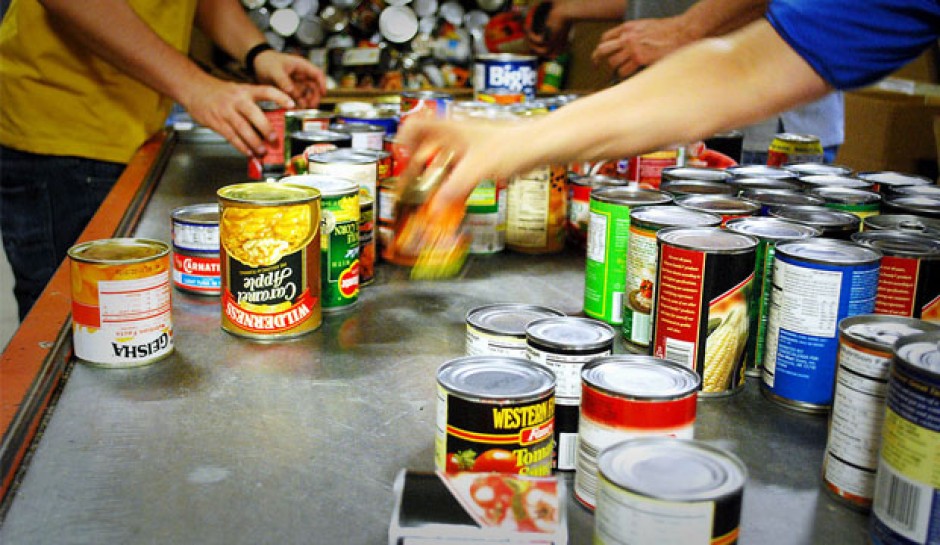
Something worth celebrating happened here recently. Nominated by members of the public, the foodbank network in the borough got a special award for its contribution to the community. The ceremony was held at the town hall, and the lovely and very dedicated food bank manager Alan was there to receive it.

As I’ve said before, this cash-strapped local council isn’t perfect, but it does try harder than most to help the growing number of vulnerable people in the area. It also values social cohension and is striving against considerable odds to address issues of inequality and poverty.

The council is being starved of funding, like all local authorities. The Local Government Association (LGA) has pointed out that overall funding for local government has been cut by more than 40 per cent in the course of this Parliament. The LGA has already called on the government to think again about getting rid of the £347m emergency welfare fund for vulnerable people facing short-term crisis. This council knows that these are the very group most in need of food banks. So it does what it can. It provides space at a peppercorn rent for the spacious warehouse and its welcome centre, and ensures food donation baskets are provided in a number of council buildings that are open to the public. The support it can provide is limited, but of a practical, hands-on nature.

Since April 2013, this borough’s Trussell Trust food banks have given out enough food to provide 35,000 meals. It has fulfilled over 1800 vouchers, which translates to about 2300 adults and 1500 children. Alan’s team has collected nearly 40 tonnes of food and distributed just over 30 tonnes through the eight welcome centres across the borough. The organisation is now fully established, with strong teams in the warehouse and the welcome centres.

Alan adds: ‘All these numbers far exceed our expectation at the beginning of the year. It is not my wish to enter the political debate but I will share with you that the vast majority of people we meet are sincere and their need is genuine. We continue to be grateful to the many churches and schools who have been the chief contributors of food.’ This, he says, has been supported by the permanent collection points facilitated by the local council and by collection points in local Tesco and Sainsbury supermarkets. The challenge continues to gather in sufficient of the less popular food items so that the volunteers can make up complete packs. The local food bank network now has a clever App that provides details of food abundances and shortages, and will help enormously (assuming donors have smartphones etc).

Some people are falling through the safety net, though. They’re very vulnerable indeed, and for a significant number food bank packs are not going to solve their problems. What they need is long-term support and intervention – from a state that’s capable of engaging with them. They deserve welfare policies that offer proper help to individuals struggling with a host of adverse circumstances, including chronic ill health. Not just sanctioning their benefits when they ‘fail’ to apply for enough ‘jobs’, or being left without benefits while they wait in limbo for decisions on employment and support allowance (ESA) to be reconsidered.

Janine, the magic of MST, and the myth of easy-to-get food bank vouchers

The new lie in circulation is that people are heading to food banks in vastly increasing numbers simply because they’re now aware that food banks exist. Was it Chancellor George Osborne who got this myth up and running earlier in 2013, when he suggested food bank use had gone up, ‘because people have been made aware of the food bank service through jobcentres’? The insulting implication being that a bunch of layabout chancers are flooding through the doors of food banks in search of freebies that ‘hard-working people’ would never dream of taking.

It’s been emphasised already, and it was good to see this addressed in the first episode of Famous, Rich and Hungry, but the message hasn’t quite got through yet: Getting a food bank voucher is anything but easy. If you want to use a Trussell Trust food bank, you need to be referred by the jobcentre, by a frontline professional such as a doctor, a health visitor, a social worker or the police. They are deemed to be best placed to identify if you’re going through a real crisis and that your need is genuine. It’s only then that a voucher will be issued.

Are thousands of people in the UK – escalating numbers every month – really jumping through those hoops to collect a three-day supply of long-life food, without being in real need of help? In six months of interviewing clients at a number of food banks in this fairly typical London borough, I’ve met very few indeed whom I thought were anything other than desperate. Most of them have problems with delayed, sanctioned or stopped benefits, or are trying to move from jobseeker’s allowance (JSA) to employment and support allowance (ESA) due to (often extreme) ill health. Most have disabilities and multiple health problems, including severe depression in many cases.

Some, like Janine (not her real name) who came in just before the weekend, are former victims of domestic abuse and experience periods of crisis when the food budget becomes impossible to manage. Janine, a mum of a 12 year-old boy and a 15 year-old girl, is starting to get her life back on track after splitting with her partner. He’s a drug addict and an alcoholic, and her children had to watch him being violent towards Janine. She says her 42-year-old ex-partner is now very ill indeed as a result of his addictions. Janine, 39, was happy for me to use her real name and be photographed, but I’ve given her a pseudonymn instead to protect her identity and that of her still-vulnerable family.

Her life hit its lowest point in October last year, after she lost the job she loved in the charity sector. By that time she’d become extremely depressed because of her partner’s problems with addiction and violent behaviour, and the effect on the children. She has no support from any extended family. Why did she need to access a food bank? Had she simply heard that food banks offered free food, and decided to head on down? No. She was referred by her council social worker, who gave her a voucher. She needed it because she is struggling to survive on £71 a week of ESA and the £56 (child tax credit and child benefit) she gets for her daughter. She’s currently paying heating of £20 a week and water rates of £7, plus £3 for her council flat rent (reduced from £38 since she lost her job). Her son of 12 moved back in with her a week ago after he was removed from his father’s residence. Janine says that while with his father he was fending for himself – running out on the streets until late at night and missing school.

So although she’s relieved to have her son back, she has another mouth to feed, but as yet no benefits in place for him. That’s what plunged her into crisis this week.

Luckily, her plight was spotted by a key person who’s been working extremely closely with her and her children. Our local council has got involved with an intensive family and community based treatment programme that originates in the US called MST (Multisystemic Therapy). It’s an approach that’s fairly new to England, and ‘blends the best clinical treatments including Cognitive Behavioural Therapy and family therapy to put parents and caregivers in control and to improve family relationships and functioning’. It aims to treat troubled young people ‘in the full context of their lives’. MST is also offering to support Janine as she tries to get back into the workforce. The MST key worker told Janine to ask her social worker for a food voucher, and Janine says the only reason she got it is ‘because my boy came back to live with me’. She had only ever used the food bank once before, with a voucher.

She’s evangelical about the positive impact the programme is having – given that it’s a small team based out of a local health centre: ‘I suffer from really bad depression, and they’ve been brilliant to me. They’re helping me sort out my finances, and that help is ongoing. My 15-year-old daughter suffers from anxiety, and is seeing a paediatrician(within the MST programme). They’re really good. They’re helping me with my CV and with ‘getting back into work.’

Before MST got involved, local council social services ‘didn’t provide the support, to be honest’, in Janine’s view. ‘My ex had alcohol and drugs problems, but the council still let my boy live with his father.’ She says he daughter has ‘a bit of an eating disorder, and is losing too much weight – myself and MST are keeping an eye.’ Her daughter did not go to school for six months last year, but she’s now in a good specialist school for children who have witnessed violence and suffer from conditions such as anxiety and depression. ‘There’s an open door at all times for her to go in and out and talk to people. She’s doing really well, and is ready for her exams. She’s caught up.’

It’s still too early to feel that things have permanently improved for the family, but so heartening to hear Janine say that MST is the best thing that’s ever happened to her: ‘It’s changed my whole life. My daughter is so much more relaxed. The people from MST turn up at school and ask her if she has any problems.’ Her account of why she was offered a food bank voucher should be read alongside the stories of greedy, dishonest, food bank clients that are starting to feature in some sections of the media.