Kevin sanctioned on Work Programme and now begging for food

Kevin sanctioned on Work Programme and now begging for food
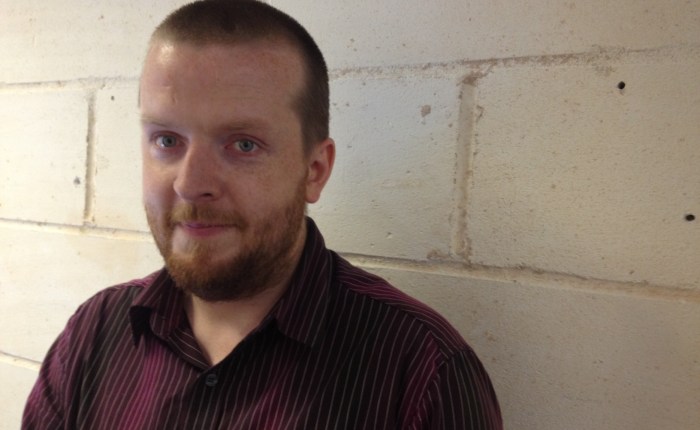
Kevin Jobbins, who's living on £7 a fortnight for food, following a benefit sanction
Kevin Jobbins, who’s living on £7 a fortnight for food, following a benefit sanction

How does it feel to be “living” on a budget for food of £3.50 a week? Kevin Jobbins is doing exactly that, but the more you think about it, the less appropriate the concept of  existence or survival seems in this context. To survive  conjures up images of Everest expeditions  – involving a set of risks voluntarily  endured  by explorers who’ve personally opted to challenge their own physical and emotional limitations.

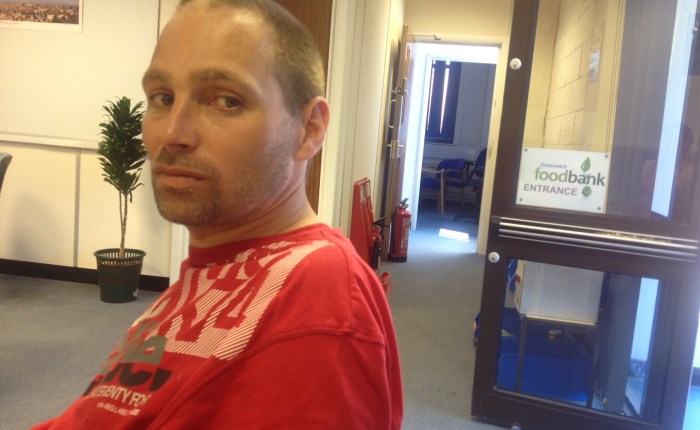
Kevin, on the other hand, came into the Greenwich Foodbank   because  he’s  not  surviving. The Department for Work and Pensions (DWP) has failed to reinstate his benefits following a sanction in April. Kevin is 39, and is  receiving employment and support allowance (ESA). He’s waiting to go into detox treatment for drug and alcohol issues and is also on the waiting list for surgery on his feet for problems  linked to his time as a homeless person. Despite his multiple health issues, he was registered with a Seetec job club.

He was sanctioned for missing an appointment with Seetec. He says he had no option,  as he had to look after his two year old son that day. Since April his benefit rate has plunged from £202 a fortnight to £47.  He says that Seetec have told him the sanction has been lifted, but that the job centre in Woolwich says it hasn’t. His housing benefit was stopped as a result, but has now been restarted. But out of the £47 he has to pay £9 for council tax, £10 as a contribution to rent, £10 for electricity and £10 for gas. So that leaves about £3.50 for food.

The result? “I’m begging for food or nicking stuff. I got caught in Tesco. I’m also paying £10 a fortnight in court fines. This is the first time I’ve had to use a food bank. I’m angry. I don’t think I should have to beg for food.  I should have my money reinstated.  I am literally living hand to mouth.” Kevin, who’s on pain medication, adds: ‘”If I can’t nick a sandwich from Greggs I try to beg a couple of pot noodles.”

Should Kevin have been referred to the Work Programme given the extent of his health and addiction problems, and what help has it been to him? The sanction this ill man had imposed on him for not turning up to an appointment has done nothing other than to push his life further into chaos and undoubtedly towards worse health.

For whose benefit? Mike Sivier at Vox Political has flagged up how much money has been paid to Work Programme providers from when the scheme began until March 31 this year. His post links to  alittleecon, who highlights that since the programme began, 39% of  the money paid to providers – who are mainly private sector organisations – has come from the “attachment fee”. The DWP document publishing the Work Programme costs is here.  For the first year of the programme, the attachment fee was £400, the second year it was £300 and for last year £200. From July, the fee will no longer be paid.

To quote from the alittleecon post: “To date then, on this ‘paid by results programme’, the Government has paid providers £538m (out of a total of £1.372bn) just for taking people on their books and before they have helped a single person into work.” With this payment for doing nothing now ended, will we see Work Programme providers start to walk away?” Alittleecon estimates that around 1.72 million people have been attached to the Work Programme since it began, and the DWP is saying that over the same period there have been 296,000 job outcomes,  “so that means only about 17% (1 in 7) have found work lasting at least six months – not a great return for a spend of £1.4bn, particularly when you think that a lot of these people would have found work anyway”.

This system has let Kevin down badly. Kevin has been told to inform that food bank manager here if the job centre fails to confirm early this week that his benefit has been reinstated. I’ll update on this. Are more and more individuals ending up like him – vulnerable sick people sanctioned while on the Work Programme and effectively left to starve and steal to stay alive – begging on the streets for pot noodles?

Thanks to Kevin and the many people who use the food bank who’ve decided to speak to me.


Maeve: The food bank volunteer

Maeve: The food bank volunteer


Maeve Adams, a committed warehouse volunteer at Greenwich food bank

While the focus of this blog has been on the personal stories of food bank clients, I thought I’d mention what goes on behind the scenes, and try to find out what makes the Trussell Trust food banks here in Greenwich run so smoothly. I’m also going to try to find out why people want to help out as volunteers.

Greenwich food bank currently runs seven food banks throughout the borough. Thanks to the continuing support of the Royal Borough of Greenwich – and its partner organisation Greenwich Leisure Ltd, Greenwich food bank opened two new public donation points earlier this year at the Arches Leisure Centre in Trafalgar Road, Greenwich and at Charlton House in Charlton. This meant that people living in the west of the borough could donate more easily. There are already donation points in Woolwich and Eltham  Centres, Greenwich Community College, Tesco Extra and Sainsbury’s in Eltham.

The food bank’s network of churches across the borough also provides collection points, and many of the schools in the borough also donate, particularly around Harvest Festival time. The amount of food donated seems to be on the increase, as awareness grows about the need for food banks.

A small but committed army – the vast majority of them volunteers – keeps the show on the road. In Greenwich borough there is one central food bank warehouse, where food is sorted by volunteers according to type and its ‘best before’ date. They also check it is undamaged, then pack it into boxes and store it, ready for use. Food is then taken to foodbank centres by van, where it’s made up into food parcels ready for use.

The Greenwich food bank operation is thriving in no small part because of its volunteers of all ages and background. Many of them are drawn from local churches. Some are secondary-aged children helping out for an hour or two as some form of local community activity. A number of volunteers work ‘front of house’ – greeting clients who bring in food vouchers issued by frontline professionals such as social workers, GPs and Citizens Advice Bureau staff. If facilities are available – as is the case in Eltham – they’ll get a cup of tea and the chance of some emotional support as well as an emergency food supply. A lot of ‘signposting’ can get done at this point, if clients can spare the time and energy to talk. The volunteers I see are great at engaging with the people who come in,. They try their best to offer useful help, or whatever it is that someone needs most that day.

Some clients just want a person they can talk to who will actually take their minds off the harsh realities of the ghastly situation they’re in.  Sometimes they don’t want ‘solutions’. They might want help with a crossword rather than analysis of the likely outcome of their application for employment and support allowance.

The people I’ve seen are instinctively good at knowing what clients really need. Yes, they need food on the table, but more than that they want to be valued for who they are. Many of the clients end up wanting to volunteer at the food bank themselves.

Maeve Adams, a lovely lady with a grown-up daughter, is long-standing volunteer in the Eltham warehouse. She doesn’t meet clients, as her role is to sort out the donations as they’re received. She’s very committed indeed, and has been helping here for over a year. She dedicates a couple of hours each Wednesday and Friday. Why does she spend so much of her free time volunteering? ‘The first time I heard about food banks was on the news. I didn’t realise there was still a need for food banks. I’m not naive, but I didn’t realise they still existed. That was a shock. I really enjoy helping out here.’

She does have religious convictions – she’s a Catholic – and for her it’s about wanting to give something back to the community. ‘We’ve all got our own individual ways to feel wanted and needed, and for me I feel that I’ve got that balance. There are people worse off than me. The people here volunteer for different reasons. There are different age groups, but everyone here has the same intentions, so it’s easy to blend in. We want to do something good.’

Can England’s A&E units spot the malnourished? Mark’s story revisited

Can England’s A&E units spot the malnourished? Mark’s story revisited
Mark Bothwell, who's on jobseeker's allowance. He says he hasn't been eating properly for years.
Mark Bothwell, who’s on jobseeker’s allowance (JSA). He says he hasn’t been eating properly for years.

Mark Bothwell (above) came into the London food bank today. He’s had a painful problem with his shoulder for some time that leaves him unable to accept many types of physical work, and he also has depression. He’s been waiting for months for his claim for employment and support allowance (ESA) to be processed. Not that this 29-year-old is likely to be better off financially by transferring over from JSA, but he would at least be relieved of  some stress. He says: ‘It’s a job-stopping illness, so the positive thing (about changing benefits) is not having to worry about job hunting.’

Last week, he described two recent trips to the accident and emergency (A&E) unit at the local hospital – the Queen Elizabeth in Woolwich. He says that terrible chest pain drove him to seek help, and that a viral infection causing inflammation of the outer lining of the heart was suspected. Mark, who is already on strong medication prescribed by his GP for his shoulder pain, had an adverse reaction to one of the medications given at the A&E. It upset his stomach and caused ‘a lot more pain’. This extra pain meant he had to make a second visit to A&E later that week. While the doctors took a family history during his visits to cover heart issues, and did blood tests, an ECG and X rays, he says the doctors didn’t ask about his circumstances. ‘They didn’t ask if I’d been eating properly for the last few months. Actually, I’ve not been eating properly on and off for years. Money has come and gone for years since I moved out of the house at 21. I was homeless for 18 months. Although I’ve had the foodbank vouchers, which has been good – it’s not been enough to cover the last four months. Even during this time (when he’s had some help from food vouchers) there have been a couple of days when I’ve not been able to take my pills because I haven’t had enough food.’ He says that recently, when he hasn’t had enough food, ‘shoplifting has crossed my mind, and this is how desperate people can get’.

Why didn’t  the doctors in A&E ask him about his circumstances, which may have flagged up the effect poor nutrition for many years could be having on his health? Could it be because the A&E unit, like many in the NHS in England, is understaffed and generally in crisis? The hospital is part of the Lewisham and Greenwich NHS trust, and this week health inspectors the Care Quality Commission published a report that was highly critical of many aspects of services at the trust, which it says requires improvement. The A &E unit at the Queen Elizabeth is deemed to be inadequate, and ‘not fit for purpose’. The inspectors, who visited the hospital in February, have serious concerns about the safety of A&E services there . They note a shortage of beds for admission to the hospital, causing a block in the system, particularly for patients in A&E. Ambulance personnel told inspectors there were regular delays in booking patients in and patients often had to be treated in the back of ambulances. They also pointed to the low staffing levels in A&E, with 29 full-time equivalent nurse vacancies and vacancies for four consultants and six junior doctors. The report also says that since the closure of the accident department at the nearby Queen Mary’s Hospital  in 2012, attendances had risen from around 300 to over 450 a day. Because of a lack of space, patients who ‘would have benefited from being able to lie on a trolley or bed were having their treatment on a chair in full view of other people’. Against this background, do the A&E staff  have the time to take detailed enough case histories?

Mark’s  food budget of about £2 a day and spells without eating adequately over many years must be impacting on his health, yet none of the doctors treating him in hospital asked him about his nutrition.  Is the NHS really capturing the facts about how many people are becoming ill, or having their health conditions made worse because of malnutrition and food poverty? The steep upward trend in the number of people being driven to use food banks indicates a rise in the number of individuals and families struggling to eat well. But as the Faculty of Public Health so clearly points out, actual food bank numbers are ‘an inadequate indicator of need, because many households only ask for emergency food help as a last resort’. So the true scale of food poverty remains hidden.

In Wales, hundreds of patients have been diagnosed with malnutrition in the past few years. New figures from a Freedom of Information Act request show 1,229 patients have been diagnosed since 2007/08. In England, primary and secondary diagnoses of malnutrition in hospitals rose from 3,161 in 2008/09 to 5,499 last year, according to figures released by health minister Norman Lamb. In November 2013 an early-day motion in the House of Commons from MP George Galloway noted a ‘doubling of the diagnoses of primary and secondary malnutrition in Bradford Teaching Hospitals NHS Foundation Trust in the years 2010 to 2013 compared to 2008 to 2010’.

Are all cases of malnutrition as a primary or secondary diagnosis being clearly identified, given the levels of understaffing and the workloads in some A&E units?  What information is being gathered by GPs? These are issues the All=Party Parliamentary Group on Hunger and Food Poverty may want to start examining closely during its inquiry.

The outlook for Mark this weekend is more positive, and he didn’t need a food voucher this week. His MRI results show a frozen shoulder, and he’ll be referred for physiotherapy by his GP.  Mark is relieved that he doesn’t need surgery, and he’s been told he should receive a letter within 10 days telling him when he’ll start receiving ESA payments. He’s finally got an appointment to access  group pain management talking therapy, which will take place once a week for 10 weeks. The depression is still there, but is ‘starting to feel a lot better’.