London foodbank life: Surreal at times, but dangerous too

London foodbank life: Surreal at times, but dangerous too
Ben Adou hasn’t received jobseeker’s allowance since early March. He came into the foodbank hungry.

I’m pondering the brutal absurdities of day-to-day life for a growing number of the people I come across at this London Trussell Trust foodbank. Sarah (not her real name), wants a job. She’s a gentle and intelligent 28-year-old law graduate with Borderline Personality Disorder (BPD). A month ago she was nearly made homeless when the hostel told her they were going to evict her. The housing association running the hostel changed its mind at the last minute, but tragically she’s considering escort work as a possible way to clear debts, including a Wonga loan at extortionate rates. What does the future hold for her after she finally worked up the courage to escape a violent home situation? Will Mark, who’s trying to battle both depression and a debilitating shoulder injury, ever get his claim for employment and support allowance (ESA) processed? It’s been more than 10 weeks now, and he’s still no clearer about when he’ll get his money. Meanwhile his health is deteriorating fast, with other worrying symptoms now developing, which have driven him to the local hospital’s accident and emergency unit.

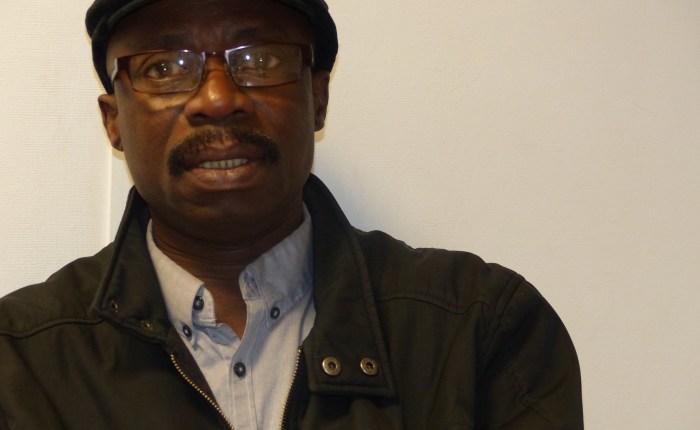
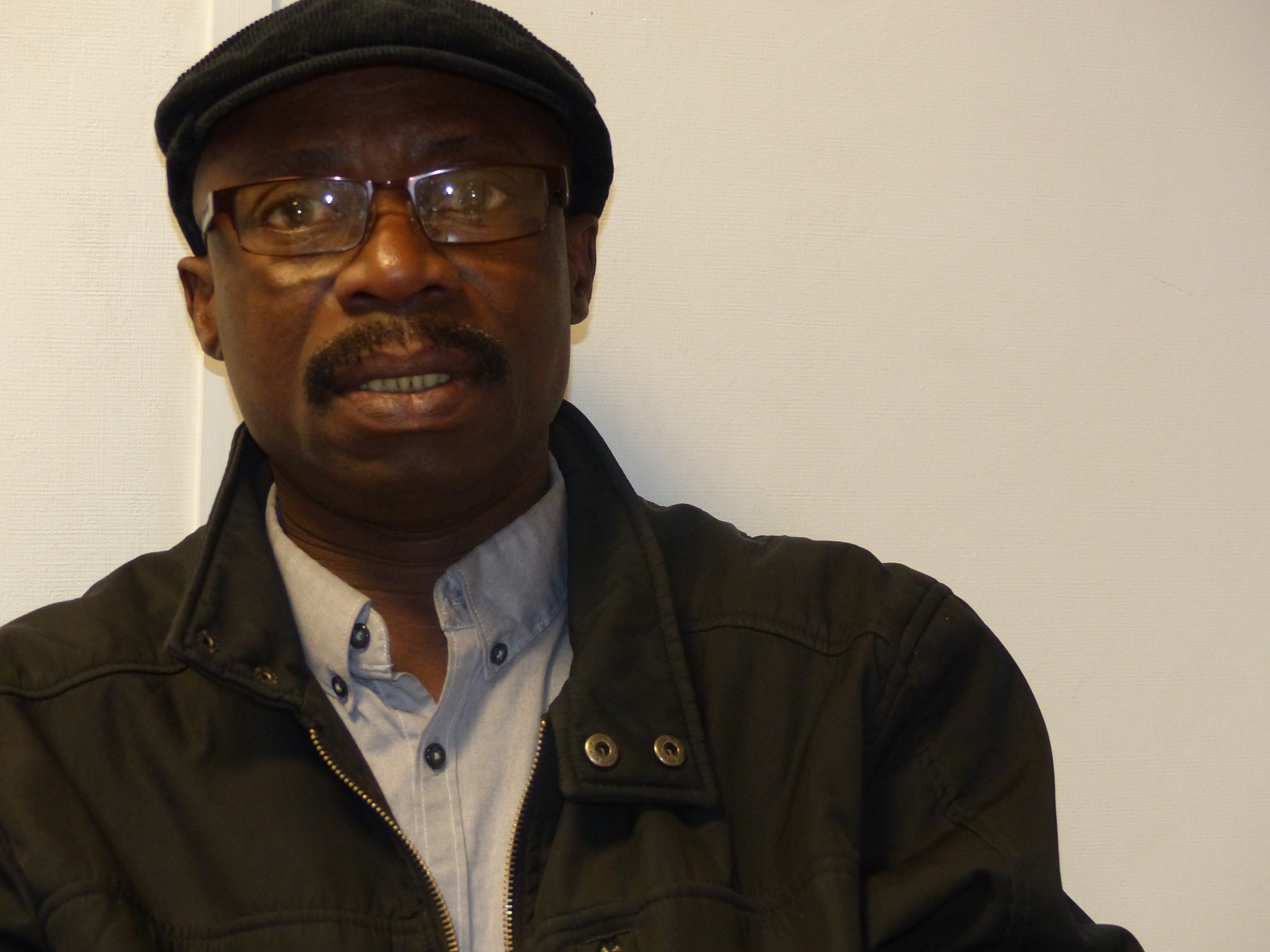
While they struggle on, Ben Adou (pictured above) came into the foodbank to share his story. Last week I mentioned that he brought along a foodbank voucher – his third. He couldn’t have survived without them, as he hasn’t received any jobseeker’s allowance (JSA) since March 7. This has plunged Ben – a widower of 56 whose wife died of cancer in 2012 – into a financial crisis. He claims housing benefit, has no savings and has nothing to fall back on. There is no safety net here. He came into the foodbank at what he somewhat ironically called lunchtime – hungry because he hadn’t been able to eat that morning. At least he was able to get some tea and a spare sandwich, and leave with his emergency pack of long-life food and some bread that had been donated that day. ‘You have brought me happiness by giving me food’, he said.

The problems started when Ben, who mostly works as a labourer, was offered a job through the controversial Universal Jobmatch scheme at the beginning of March. It turned out to be just two days of work, which he said had ‘completely messed up my JSA claim’. It’s also impacted on his ability to pay a contribution towards his rent, pay his council tax and to meet other household and phone bills. It has made it almost impossible for him to get to interviews. Crucially, of course, he can’t buy food. Any sort of a social life is totally out of the question, of course. With his JSA on hold, he now has no idea exactly when his benefit payments will resume. He called into the jobcentre to try to get to the bottom of things: ‘They said I was overpaid JSA during spells when I was working, and I disagree. They’ve put in writing that they know they owe me £431.60, but they’re saying that I owe them about £286.00 – and that this was a possible overpayment to me.’

The Government’s Universal Jobmatch website  – managed independently by private recruiter Monster – has come under much criticism. MP Frank Field said in a Guardian article, that it is ‘bedevilled with fraud’ and ‘out of control’.The Department for Work and Pensions (DWP) revealed in a letter to Field that more than 350,000 job adverts might breach the website’s terms and conditions , which specify that employers must advertise a real job, not use premium rate numbers, pay at least the minimum wage and not cost the applicant any money to start.

In the meantime, Universal Jobmatch keep on sending him texts calling him to jobs he can’t take up and job interviews he can’t attend – because he has absolutely no money to get there. A few weeks ago he passed two interviews for some work in central London, but couldn’t get the money together to travel up to the job. The day before he had been offered work starting yesterday in Morden, ‘but I had to say no because I couldn’t afford to travel there’. He has no money, so needs a job. He can’t get a properly paid job, because he has no money to get there. A week previously he had been called for a first interview for a commission-based job, then was offered an induction. It was only at that point that he found out he would have to use an Oyster card and put money on it himself to enable him to travel around London to sell products door-to-door. Needless to say, ‘this wasn’t explained at the team meeting’.

He explained to JobcentrePlus that he needed some money, but doesn’t seem to have been told that he could have been given money directly by them. There’s a fund for that sort of thing, you see. But no-one seems to be told about it. Every year in April, JobcentrePlus offices are given a budget to pay for Budgeting Loans.These are interest free loans for people on JSA and other benefits. Travelling expenses within the UK are included in the needs covered by such loans. This money comes out of the JobcentrePlus Social Fund budget.

Ben, like many of the people I meet, is dealing with this ghastly situation with tremendous resilience. But there’s only so long he can cope without long-term damage to his health and wellbeing. He is diabetic and he also has a heart problem. Kafkaesque doesn’t even begin to describe the ridiculous, complex hassles faced daily by a growing number of our most vulnerable citizens. This week we found out that committed campaigner and journalist Mike Sivier’s battle to get information on deceased former sickness benefits claimants released that is clearly in the public interest has been unsuccessful – so far. He wants an update on the number of sickness benefit claimants who have died, but a tribunal has upheld the Information Commissioner’s decision that his Freedom of Information request was ‘vexatious’. But the judge criticised both the information Commissioner and the DWP for the other reasons they put forward to prevent the death figures from being made public. From what seems to be emerging here in London, do we also now need to look more closely at the equivalent figures for people on JSA?

London is no city for young women: Will Sarah return to escort work to pay for her debts?

Down at the food bank, the volunteers hope that clients can over time move on from their challenging situations to something better. Sarah, who has featured here before, is struggling to get the proper support she needs to build a better life. She came here with a voucher a few weeks ago, worried that she was about to get evicted from her hostel. Some calls to the housing association were made, and the threat of eviction was withdrawn after her case was looked at again.

So she had a roof over her head for a while longer. But Sarah (not her real name), a 28-year-old law graduate who has battled for many years with a serious mental illness – Borderline Personality Disorder – came in again today and what she told me made my heart sink. This very intelligent, thoughtful and sensitive young woman has had to deal not only with BPD – which she sees as a life sentence – but with a violent home environment, from which she’s recently fled. Her full story is here. She came to this borough as a homeless person, because she couldn’t stay where she was. While she’s not currently at risk of being homeless again, and is receiving employment and support allowance and disability living allowance, she has considerable debts, including a loan from Wonga at the usual rates (for those of you who don’t know by now, Wonga’s rate of interest is an eye-watering 365 per cent on £150 for 18 days). She is also trying to deal with a massive bill from Vodaphone, and some student credit card debt.

Sarah told me that she thinks she may have to return to escort work to pay her debts. Why is she considering this? She explained to me: ‘I feel as if I’m in fight or flight mode. It’s horrible and wrong, but if I balance all that against the risk of sinking further and further into debt…. The place I work for gives you drivers and a bodyguard. It’s a seedy underworld, but maybe that’s where I think I belong. It’s what I know.’ When she has done this work in the past, she says she ‘feels like she can blot it out with drink and cannabis…. I’ve done it before, so I think what does another time mean to me’. This work would pay her £60 an hour cash in hand.

How does she feel about her life? ‘I’m sick of being a burden and a leech. I’m heading towards 30 and what have I got to show for it? I’m not stable enough to work full time. I can’t jump from being on benefits to funding a deposit and rent for a flat. I haven’t worked full-time since 2010.’

Sarah began the first stage of some very gruelling treatment for her BPD, but to make progress she would need to undertake another two years of therapy over about three days a week. Having left her home and pulled out of treatment, she would need to start again and access services in this borough. But the GP she has registered with has not yet received the paperwork from her old GP. So although she has been prescribed her medication, she does not yet have a community psychiatric nurse. Our food bank manager made sure she left today with details of the local self-referral mental health services and details of excellent debt advice charity Christians Against Poverty. We hope she gets appointments with both very soon indeed.

Send her all the luck in the world. She’s got more inner strength that she realises and I’m left with a sense that she will now fight to get the support she needs. The most disgraceful thing is that social, housing and welfare policies are making life more difficult by the day for Sarah and the people like her, here in London and throughout the UK.

Sarah’s story: The housing trust and council response

This week I wrote about Sarah. She told me that she was forced to flee her home some distance away in another borough because of her relative’s violent behaviour. A housing trust which runs a hostel for the homeless in Greenwich took her in after she was registered homeless, but it has handed her an eviction letter, telling her that she must vacate by April 11.

It says that if she fails to hand in her keys by 11am that day, it will be ‘forced to carry out an eviction with the Metropolitan Police present’. It adds that following a review, ‘it has been decided that the services and facilities that the accommodation provides are no longer suitable for your needs’. It does not say why that is the case. Sarah says she’s been told it’s because she’s made a number of complaints to the hostel.

Sarah (not her real name), a law graduate aged 28, moved back home after her studies and struggled to find a job. She says that because she couldn’t find work she was ‘scapegoated’ by the relative. Eventually, she left home in January for her own safety. Sarah has also been dealing with a serious mental health issue – borderline personality disorder (BPD) for many years. After pleading with them to help her, she says The Royal Borough of Greenwich registered her homeless and placed her with the housing trust.

She says the council is paying the housing trust her housing benefit, council tax and for her heating. Her main complaints about the housing trust focus on ‘intrusive’ room inspections at odd times of the day, a card meter regularly not being topped up by the staff – leaving residents without heating and hot water about one day a week – and a service charge made by the staff of £15 a week per resident. She says she was forced to the food bank because of the service charge and because she lost food when a fridge broke down for a few days.

The housing trust (not named to preserve Sarah’s anonymity) has now responded. It says it that Sarah was one of the first clients to move into the new accommodation, and that when she arrived she was given a ‘small loan and a large bag of food’.

The statement says there ‘was an issue with the heating system where the whole system had to be shut down for repairs’. It says the ‘leak in the pipe work was fixed’ On another occasion ‘the gas meter was faulty and we had to report it and accordingly waited for an engineer from the gas company to exchange the meter’. It was ‘due to those problems that there was no hot water or heating for a period of time’. The fridge wasn’t working ‘because someone from the property switched off the fridge function’.

The statement adds: ‘The service charge is for the TV licence and broadband. Gas and electric are only covered partially.’

I asked the housing trust if they were going to use a court order to evict her, but didn’t receive a reply to this. Sarah’s understanding is that they won’t do this because she has a licence agreement rather than a tenancy agreement.

According to the housing trust, there were issues that led to Sarah being given a notice to quit, but that it can only say more if she offers consent in writing. I’ve passed this information onto her. The housing trust also strongly rejects Sarah’s comment that it does not deal with drinking and drug taking at other accommodation it runs. The trust adds: ‘We are working actively and strenuously with the council to reduce homelessness within the borough and to help vulnerable adults.’

Responding to Sarah’s concern that her council case worker was not dealing sensitively with her homelessness issues, the Royal Borough of Greenwich said it had ‘not received a complaint from the resident against the actions or behaviour of any member of Royal Borough staff’. It added: ‘We are committed to ensuring that we support people who access our services in a professional manner, and in a way which is sensitive to any additional needs they may have. If the resident has concerns about her tenancy and the actions of her landlord, we would encourage her to contact the Royal Borough for advice and assistance by calling 020 8921 2618 or email housingaidcentre@royalgreenwich.gov.uk’