Quotas for food bank vouchers at job centres?

Is an unofficial quota system for food bank vouchers operating at job centres? One man who called into a food bank in this London borough recently said he was told by his job centre that they’d given out 15 vouchers already that week. Persuading the staff there that he was in need was hard work. He said he did get a voucher eventually, but his experience begs a question. How many people in genuine need of an emergency supply of food are now being refused a food voucher by job centres?

There’s already a substantial level of need in this borough – a fairly typical one for London, with its pockets of deprivation. Between April 1 2013 and the end of January this year, Trussell Trust food banks in the borough fed 3,225 people (1937 adults and 1288 children). There was a month on month increase in clients from the middle of last year leading up to Christmas.

Everyone who received emergency help will have needed to present a voucher. But it’s vital to get a clearer idea of how many are trying to access help through job centres and are being refused that essential piece of paper.

With the number of people having their benefits sanctioned, or experiencing other delays (for example while their employment and support allowance entitlement is reassessed) on the increase, are job centres under orders to limit vouchers?

Accessing help to eat at short notice is becoming a fact of life for a growing number of people in this very average area of London. One experienced food bank helper here, whose day job is as an outreach worker in children’s services, says that half of the people coming to his food bank are there because of benefit sanctions. He adds: ‘A lot of them are on housing benefit. They have a roof over their heads, but they still have to eat.’ The most worrying thing is that they may be the ‘lucky’ ones, who managed to get their hands on that all-important voucher.

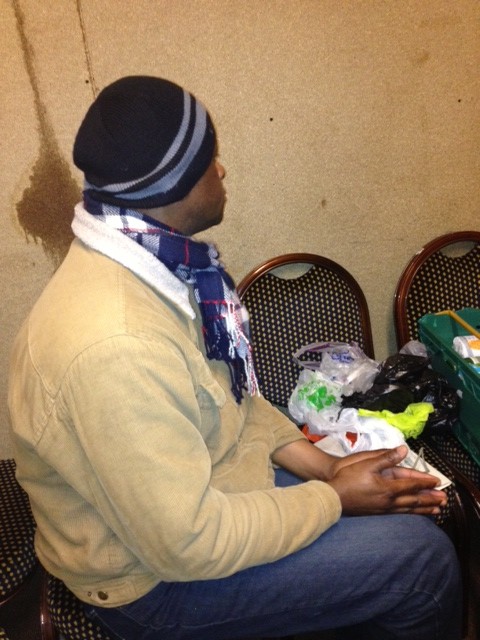
The food bank helps depressed Femi as he recovers from a suicide bid

femifeb2014

As soon as I met Femi (not his real name) at this London food bank, I felt I knew him already. It turned out that as soon as he started talking I realised that I’d met his wife some months ago. Her story is here. Elizabeth (not her real name) came into the food bank for support after her husband had tried to hang himself and had become an inpatient at the local mental health trust.

As soon as he began to tell me that he was from Nigeria, had three young children (aged 8, 6 and 11 months) and started studying accountancy in London before he ran into difficulties, I’d a strong feeling I’d been talking to his wife. The lovely Elizabeth had made a deep impression on me as she described how her family’s life had got so hard. She said she’d just about managed to stop her husband as he had tried to hang himself at home in September, and of how her young daughter (of 8) had to run and get a knife to help cut her husband down in time.

What drove Femi, 34, who came here in 2008 to study, to the brink of suicide? He told me he had been working in banking back in Nigeria and came to England in search of a better life for himself and his family. Initially he arrived on his own to start studying for his ACCA (Association of Chartered Certified Accountants) exams. “The UK was like a dreamland to me. My dad came here in 1975 and he told me many things about it. I lost my mum (in Nigeria) 30 years ago, so I had to grow up very quickly. I left home when I was 12.” When he was growing up in Nigeria he had to spend a lot of time fending for himself. He put much of his own savings into paying for his studies in London, with some support from his father in Nigeria. I also remembered that Elizabeth said her husband had worked when he could while he was studying.

But by 2010, things were getting tough. His wife joined him, but noticed that he was struggling with things like brushing his teeth and keeping clean. “I went to the GP and was diagnosed with depression. I was so ashamed.” He says that there’s a massive stigma in Nigeria about having depression, so he didn’t think he could share his feelings with what remains of his family back in Africa. Despite all, he still managed to pass the exams before he had to leave his course without completing it. “I keep my results on a piece of paper in my pocket, just to remind me of what I’ve done.”

The biggest blow of all came on September 17 last year, when the outcome of his immigration appeal came through. He had spent all his money – and received some financial help from friends – to fund an appeal on health grounds against the decision by the Home Office to refuse his immigration application. The process cost £3,000, to include the costs of the tribunal, £1,400 to the Home Office and £1,340 to the solicitor who took on his case. The news was the trigger for the already depressed Femi to carry out his suicide attempt. “I tried to commit suicide in the middle of the night. My daughter saw me.”

Femi sees the judge’s appeal decision as deeply unfair: “The judge said I should not be treated here. I said that I did not come here with depression. I worked in banking before I came to England. I took the UK as my home.” He even managed to donate £15 to charity every month for a while when he was working. He now has no money to fall back on, and he and his family are facing eviction from his privately-rented house.

He has nothing but praise for the social worker involved with the family, and he’s also receiving intensive treatment three days a week from the local mental health trust. The family has had some emergency payments from the council (which I’ve noticed tries so much harder than the other council on our doorstep to help the vulnerable when it can), but the money has to cover everything and there’s not often enough to buy adequate food. There have been times when the children didn’t have anything to eat. So the social worker has given the family the occasional voucher for the food bank. The family really needs this extra support, but the food bank can’t ever be more than a stop gap to cover an immediate crisis.

The couple only realised recently that Elizabeth is pregnant again – she had been taking contraceptives so this came as a great shock – with the new baby due in May. Femi is once again appealing the decision to refuse his immigration application on health grounds, and the hearing is due at the end of this month. The council is looking at how the family might be rehoused, but of course there are no guarantees of anything. He’s still crying every day, he tells me…

He went home last night with some food for his children, and that, at least is a small comfort.

Wish him well.

Mark and the Jobseeker’s Allowance/Payday Loan Diet

House prices aren’t the only thing taking off in London. There’s been a big spike recently in the numbers using this Trussell Trust food bank. Last week  13 clients came in with their vouchers during the three-hour weekly slot that  we’re open. That’s a significant increase on before Christmas. I’ll be trying to collate numbers this week to see if that  January increase is reflected at the other food banks in the borough.

One of the clients who came in just before the weekend was Mark, an endearing  man of 29, who had used another food bank at the start of the week. That supply would have seen him through for a minimum of three days. This time he didn’t have a voucher (the worker from the job centre who usually allocates them wasn’t available), but he decided to call in with us anyway. He brought us a box of biscuits he’d received from the food bank to say thanks for the earlier help. We weren’t able to give him a nutritionally balanced package of food without a voucher, but we gave him some bits and pieces that were still in date, and a loaf of bread that had been brought in that morning.

Mark has been receiving  jobseeker’s allowance (JSA) for some time. His last job was agency work as a barman and waiter. The company got bought out, and Mark ended up being paid two weeks after he did a shift. He told me: “I could be called up on the day, and I had to pay out £40 a week for my travel card, as the work took me all over London. I just couldn’t afford it.”

He tells me that he normally sets aside a small amount (£18-40) a fortnight for food. He carefully juggled all this and it was tricky. But recently things got harder, as he started paying off a hire purchase agreement to BrightHouse for a PC. He uses the PC (which he describes as his lifeline)  to prepare and send off job applications. Being poor is expensive. A typical BrightHouse HP agreement involves an APR of 70 per cent. He’s also paying off another loan from The Money Shop, where short-term loans of up £1,000 typically have an APR of 2961.4 per cent. He says his problems were also made worse (probably before Christmas) by bills coming out of his account earlier than he expected.

To make matters worse he got ill in October, when he hurt his right shoulder and arm, and the right side of his neck. This really affected his original  food budget (which assumed one to two meals a day), as the painkillers he’s taking require him to eat more regularly. It got to the point where he has needed to pay out £4.40 a week more than is paid in – and that’s before buying food. The injury is in danger of turning into a chronic health problem. Mark is also paying a Sky subscription. Some will point a finger here and say he shouldn’t be doing this if he can’t afford food. But try standing his shoes (size nines – needing superglue as the soles have come off) for a while…

Mark has a kind heart. On the day he was in he put his name down to become a volunteer at the food bank. He also helps his neighbour (in her 80s) to carry her heavy shopping. That won’t be doing his arm much good. What does he think will happen next, and what would he like from life in the future? I tell him I see him as very good with people and extremely thoughtful.  “In the short term I’m going to keep struggling to feed myself. A nice steady job would help and somewhere of my own to live (he has slept on a friend’s sofa for more than six years).” I suggest he goes back to see his GP and asks for better medication, some physiotherapy and help with applying  for employment and support allowance (ESA). The higher rate of ESA would make a difference until his health improves.

He looks gaunt, and says that he’s lost substantial amounts of weight over the last few years – about three stones, he thinks. Being on JSA is not good for your health. The Council of Europe in Strasbourg has recently said that welfare payments in the UK , including JSA (£67 a week) are manifestly inadequate. Our Government doesn’t agree.