Kevin sanctioned on Work Programme and now begging for food

Kevin sanctioned on Work Programme and now begging for food
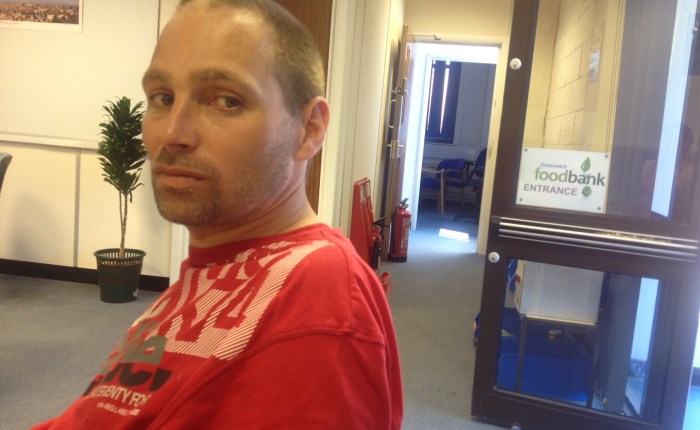
Kevin Jobbins, who's living on £7 a fortnight for food, following a benefit sanction
Kevin Jobbins, who’s living on £7 a fortnight for food, following a benefit sanction

How does it feel to be “living” on a budget for food of £3.50 a week? Kevin Jobbins is doing exactly that, but the more you think about it, the less appropriate the concept of  existence or survival seems in this context. To survive  conjures up images of Everest expeditions  – involving a set of risks voluntarily  endured  by explorers who’ve personally opted to challenge their own physical and emotional limitations.

Kevin, on the other hand, came into the Greenwich Foodbank   because  he’s  not  surviving. The Department for Work and Pensions (DWP) has failed to reinstate his benefits following a sanction in April. Kevin is 39, and is  receiving employment and support allowance (ESA). He’s waiting to go into detox treatment for drug and alcohol issues and is also on the waiting list for surgery on his feet for problems  linked to his time as a homeless person. Despite his multiple health issues, he was registered with a Seetec job club.

He was sanctioned for missing an appointment with Seetec. He says he had no option,  as he had to look after his two year old son that day. Since April his benefit rate has plunged from £202 a fortnight to £47.  He says that Seetec have told him the sanction has been lifted, but that the job centre in Woolwich says it hasn’t. His housing benefit was stopped as a result, but has now been restarted. But out of the £47 he has to pay £9 for council tax, £10 as a contribution to rent, £10 for electricity and £10 for gas. So that leaves about £3.50 for food.

The result? “I’m begging for food or nicking stuff. I got caught in Tesco. I’m also paying £10 a fortnight in court fines. This is the first time I’ve had to use a food bank. I’m angry. I don’t think I should have to beg for food.  I should have my money reinstated.  I am literally living hand to mouth.” Kevin, who’s on pain medication, adds: ‘”If I can’t nick a sandwich from Greggs I try to beg a couple of pot noodles.”

Should Kevin have been referred to the Work Programme given the extent of his health and addiction problems, and what help has it been to him? The sanction this ill man had imposed on him for not turning up to an appointment has done nothing other than to push his life further into chaos and undoubtedly towards worse health.

For whose benefit? Mike Sivier at Vox Political has flagged up how much money has been paid to Work Programme providers from when the scheme began until March 31 this year. His post links to  alittleecon, who highlights that since the programme began, 39% of  the money paid to providers – who are mainly private sector organisations – has come from the “attachment fee”. The DWP document publishing the Work Programme costs is here.  For the first year of the programme, the attachment fee was £400, the second year it was £300 and for last year £200. From July, the fee will no longer be paid.

To quote from the alittleecon post: “To date then, on this ‘paid by results programme’, the Government has paid providers £538m (out of a total of £1.372bn) just for taking people on their books and before they have helped a single person into work.” With this payment for doing nothing now ended, will we see Work Programme providers start to walk away?” Alittleecon estimates that around 1.72 million people have been attached to the Work Programme since it began, and the DWP is saying that over the same period there have been 296,000 job outcomes,  “so that means only about 17% (1 in 7) have found work lasting at least six months – not a great return for a spend of £1.4bn, particularly when you think that a lot of these people would have found work anyway”.

This system has let Kevin down badly. Kevin has been told to inform that food bank manager here if the job centre fails to confirm early this week that his benefit has been reinstated. I’ll update on this. Are more and more individuals ending up like him – vulnerable sick people sanctioned while on the Work Programme and effectively left to starve and steal to stay alive – begging on the streets for pot noodles?

Thanks to Kevin and the many people who use the food bank who’ve decided to speak to me.


Summer’s here: Thoughts turn to feeding the kids in the holidays.

London looks good when the sun’s out. But a holiday, or even a day or two at the seaside is an impossible dream for a growing number of young families. A study published today shows that Britain will have 3.5 million children living in poverty by 2020. Another report released today by charities Oxfam, Church Action on Poverty and the Trussell Trust reveals that more than 20 million meals were provided to people in the UK last year – a breathtaking 54% rise on the previous year.

Holiday plans get pushed much further down the list when you’ve got a number of young mouths to feed and no money to do it with. Tonight, the terrible situation faced by growing numbers of youngsters whose parents are struggling to put together the money for their meals will be shown in a Channel 4 documentary called Breadline Kids. It’s on at 7.35pm. One mum on benefits mentioned in the programme has £3.60 a day to spend on herself and her two daughters. This figure seems to tie in with the one given to me by a number of single adults I’ve met at the London food bank. A number of them had been attempting to feed themselves on a budget of £2 a day – or sometimes less.

The accounts of the children are very touching, but hard to listen to. Since the recession began over 1,000 breakfast clubs have been started for primary school children. The problem of children arriving at school hungry has been growing significantly over the last two years. When schools are out for six weeks this summer, children will suffer even more, as the hardest-pressed family budgets melt down to nothing.

Ray Woolford runs the We Care advice centre in South-East London, which provides help and support to struggling individuals and families. The centre also sells fresh and long-life food at very low cost to those in need. He is very concerned about what will happen to families with school-aged children this summer. ‘More and more people are saying they are terrified about how they are going to feed their children.’

He’s currently trying to come up with a solution in time for the mass exodus when schools break locally: ‘We’re trying to find kitchens so that we can run breakfasts and lunch clubs. If not, then we will have food parcels for people to take, with milk and cereals. If we can’t get kitchens then we will create summer kitchen packs.’ He’s also considering liaising with local cafes.

In Blackpool, breakfasts are now being offered to all primary school children. Increasingly, local communities will start to become more aware of the scale of the summer destitution on their doorsteps. I’ve just heard of the case of parents with an 11-year-old daughter who’ve all just spent a week sleeping in a London park. These dreadful cases won’t and can’t remain hidden much longer.

Starvation, shoplifting, prison, some quiche and a cheese knife: David’s story

Starvation, shoplifting, prison, some quiche and a cheese knife: David’s story

David Goddard, who says he was forced to shoplift after JSA was withdrawn. He ended up in prison.
Here in the UK, the daily experiences of  the increasing numbers of people who’ve had  benefits sanctioned or removed aren’t discussed much across the media. Often individuals seem to drop off the public services radar, and no-one appears to be looking out for them. Many become homeless.

There seem to be fewer sources of help available now for the destitute.  The number of support workers, social workers, GPs  or probation officers with the time and resources to help a client with complex issues appears to be dwindling. The  ‘multi-agency approach’ seems like a sick joke now – unless you know differently?

Last night, at the Jerico Road project in Catford, South-East London, I spoke to David Goddard, a 27-year-old who comes from South-West England, but has moved around constantly in the last year. He’d come along to this church-based support project for the regular Wednesday night hot meal –  alongside others  who’ve ended up at the sharp end of the austerity experiment in London. Quite a few of the 90 or so people attending this week are homeless. David is one of them.

He very honestly laid out what’s happened to him since February 2013, since he lost his job in catering in Gloucester. Before that he had run raves within the alternative scene and had a record label. He has also worked part-time in a nightclub and as a part-time carer. After losing his catering job he spent six weeks with no money while waiting for his Jobseeker’s Allowance  (JSA) claim to be processed. During this time he had to borrow money from family to survive. By the end of March/early April 2013 he’d been suspended from JSA for a week by the Department for Work and Pensions (DWP), for apparently missing an interview. He then says he got a letter through saying his JSA had been cancelled. He said: ‘I then spent the next month or two seeing if the DWP would give me an interview, filling in applications for a fresh claim online, but not getting any texts or acknowledgements.’

At this stage things took a substantial turn for the worse: ‘I was back taking heroin, and I got made homeless, because I’d moved into a family member’s home, but had to move out because that person said they couldn’t let me continue to live there unless I got benefits. But Gloucester Council wouldn’t pay me housing benefits, because I was living in a family member’s house. Then I started shoplifting. I’m not proud of it, but if  you went 24 hours without food you will shoplift. By the end of the summer I was taking enough to survive.’ At this stage, he was also paying for the heroin that way.

He got in touch with the local food bank, but he says they told him they couldn’t help unless he was on employment and support allowance (ESA). He couldn’t find anyone who would give him a voucher to access the food bank. He says he tried the jobcentre and Citizen’s Advice, to no avail.

Between July and Christmas 2013 David was arrested 10 times as he moved around the country, mostly for shoplifting food. Once, when shoplifting for a meal, he was arrested  for possession of some quiche and a cheese knife to eat it with. On that occasion he was charged with possession of a blade. The shoplifting happened in various locations. He ended up in court six times, ‘but they did not actually prosecute me’, and the cases were postponed.

He moved to Southall in West London last November while on bail – at which point he says he was ‘off heroin – but shoplifting to survive’. Southall put him in a probation house. But on Boxing Day he was arrested for stealing a microwave dinner from Tesco. At that point, he says ‘they stacked up nine months of shoplifting charges, plus charges for common assault’ – he got in a fight with a security guard and a roadsweeper who tried to stop him stealing the meal – plus criminal damage and theft of a motor vehicle and put him inside for two and a half months from New Year’s Day 2014.

While he was initially in prison in Wormwood Scrubs, he says he then got shunted  at very short notice to a host of  prisons to attend nearby hearings on the other accumulated charges. During this series of ‘expeditions’, he was shifted to Wandsworth, Bristol, Leicester, and Hewell (near Redditch, Worcestershire) prisons in succession. David was released on March 28, with a travel warrant to get him to London, but without a probation officer. He had a JSA payment of £140 that had hit his account in December from a fresh claim made on November 6th. But this had to last him  ‘until my benefits came through, so I was homeless again’.

He headed back to his old shared probation house in Southall: ‘Everything I had was in that house. Eight suitcases of my property and my portfolio on arts, graphics and fashion work that I was planning to take with me to university interviews, and my computer.’  He says that he and a number of his friends were very interested in design, ‘and when I was in prison I spent my time drawing and sketching’. But he couldn’t get access to the house, and couldn’t contact the support workers, because ‘every number had changed’.

Next he submitted a further fresh JSA claim to the DWP in Catford, South-East London on April 14th, and was offered a place at a housing association hostel for the homeless in nearby Lewisham on April 16. He received one JSA payment after that, but says that because he had to attend an interview back at Gloucester Council, ‘I missed a jobcentre interview in Catford, so the DWP cancelled my claim’  He says he spent six weeks at the hostel sleeping on the floor in a sleeping bag  ‘in one large room with seats and a television, sharing with 25 men and women’.

He believes some of those in the room were aged no more than 16 or 17. It’s very hard to see how treating a group who are vulnerable by nature of being homeless in this way could comply with any safeguarding or duty of care responsibilities. Are these people really safer here in this room than they are on the streets?

David says he was ‘kicked out’ of  the hostel when he ‘got into a verbal disagreement’ with another client that then turned into a physical fight. He left last Friday, May 30. He’s now squatting in a unit on an industrial estate that’s being used to store scrap metal. There’s no electricity there.

The dedicated volunteers at the Jerico Road project are going to do what they can to help David. They’ve fixed a meeting with him very soon to talk about his benefits and housing situation. One of the great aspects of this church is its focus on trying to tackle underlying problems such as debt, addiction and homelessness.

David wonders whether his past involvement in the alternative scene and in running raves is counting against him when it comes to looking for a job. He says the past five years have been tough ones for him and his friends from the former scene. ‘Lots of people have been shut down from doing music events, and a lot of my friends have been screwed over. Three of my friends have committed suicide in the last few years.’  He wonders if he’s ‘on a list’.

Maybe David would have ended up on the streets without that initial JSA suspension in Gloucester, but at the very least he was destabilised once that small amount of regular money was withdrawn. According to the latest Office for National Statistics’ (ONS) crime survey released in April, shoplifting is up 6 per cent year on year, while overall crime has fallen significantly. The government is still arguing that there is no link between welfare reforms and the use of food banks.  Is it equally convinced that benefits sanctions don’t lead directly to desperate people shoplifting to feed themselves?