Can England’s A&E units spot the malnourished? Mark’s story revisited

Can England’s A&E units spot the malnourished? Mark’s story revisited
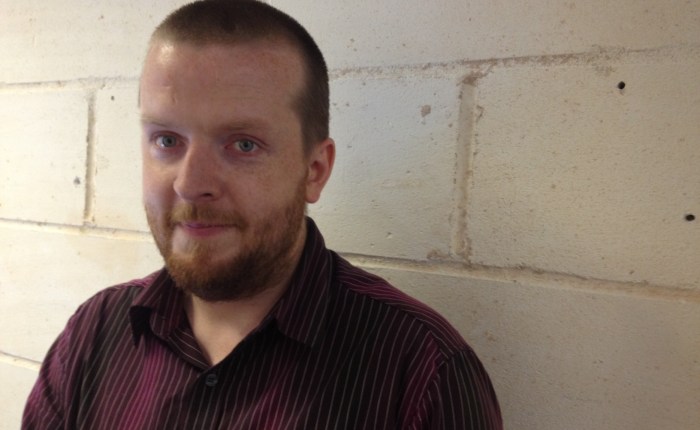
Mark Bothwell, who's on jobseeker's allowance. He says he hasn't been eating properly for years.
Mark Bothwell, who’s on jobseeker’s allowance (JSA). He says he hasn’t been eating properly for years.

Mark Bothwell (above) came into the London food bank today. He’s had a painful problem with his shoulder for some time that leaves him unable to accept many types of physical work, and he also has depression. He’s been waiting for months for his claim for employment and support allowance (ESA) to be processed. Not that this 29-year-old is likely to be better off financially by transferring over from JSA, but he would at least be relieved of  some stress. He says: ‘It’s a job-stopping illness, so the positive thing (about changing benefits) is not having to worry about job hunting.’

Last week, he described two recent trips to the accident and emergency (A&E) unit at the local hospital – the Queen Elizabeth in Woolwich. He says that terrible chest pain drove him to seek help, and that a viral infection causing inflammation of the outer lining of the heart was suspected. Mark, who is already on strong medication prescribed by his GP for his shoulder pain, had an adverse reaction to one of the medications given at the A&E. It upset his stomach and caused ‘a lot more pain’. This extra pain meant he had to make a second visit to A&E later that week. While the doctors took a family history during his visits to cover heart issues, and did blood tests, an ECG and X rays, he says the doctors didn’t ask about his circumstances. ‘They didn’t ask if I’d been eating properly for the last few months. Actually, I’ve not been eating properly on and off for years. Money has come and gone for years since I moved out of the house at 21. I was homeless for 18 months. Although I’ve had the foodbank vouchers, which has been good – it’s not been enough to cover the last four months. Even during this time (when he’s had some help from food vouchers) there have been a couple of days when I’ve not been able to take my pills because I haven’t had enough food.’ He says that recently, when he hasn’t had enough food, ‘shoplifting has crossed my mind, and this is how desperate people can get’.

Why didn’t  the doctors in A&E ask him about his circumstances, which may have flagged up the effect poor nutrition for many years could be having on his health? Could it be because the A&E unit, like many in the NHS in England, is understaffed and generally in crisis? The hospital is part of the Lewisham and Greenwich NHS trust, and this week health inspectors the Care Quality Commission published a report that was highly critical of many aspects of services at the trust, which it says requires improvement. The A &E unit at the Queen Elizabeth is deemed to be inadequate, and ‘not fit for purpose’. The inspectors, who visited the hospital in February, have serious concerns about the safety of A&E services there . They note a shortage of beds for admission to the hospital, causing a block in the system, particularly for patients in A&E. Ambulance personnel told inspectors there were regular delays in booking patients in and patients often had to be treated in the back of ambulances. They also pointed to the low staffing levels in A&E, with 29 full-time equivalent nurse vacancies and vacancies for four consultants and six junior doctors. The report also says that since the closure of the accident department at the nearby Queen Mary’s Hospital  in 2012, attendances had risen from around 300 to over 450 a day. Because of a lack of space, patients who ‘would have benefited from being able to lie on a trolley or bed were having their treatment on a chair in full view of other people’. Against this background, do the A&E staff  have the time to take detailed enough case histories?

Mark’s  food budget of about £2 a day and spells without eating adequately over many years must be impacting on his health, yet none of the doctors treating him in hospital asked him about his nutrition.  Is the NHS really capturing the facts about how many people are becoming ill, or having their health conditions made worse because of malnutrition and food poverty? The steep upward trend in the number of people being driven to use food banks indicates a rise in the number of individuals and families struggling to eat well. But as the Faculty of Public Health so clearly points out, actual food bank numbers are ‘an inadequate indicator of need, because many households only ask for emergency food help as a last resort’. So the true scale of food poverty remains hidden.

In Wales, hundreds of patients have been diagnosed with malnutrition in the past few years. New figures from a Freedom of Information Act request show 1,229 patients have been diagnosed since 2007/08. In England, primary and secondary diagnoses of malnutrition in hospitals rose from 3,161 in 2008/09 to 5,499 last year, according to figures released by health minister Norman Lamb. In November 2013 an early-day motion in the House of Commons from MP George Galloway noted a ‘doubling of the diagnoses of primary and secondary malnutrition in Bradford Teaching Hospitals NHS Foundation Trust in the years 2010 to 2013 compared to 2008 to 2010’.

Are all cases of malnutrition as a primary or secondary diagnosis being clearly identified, given the levels of understaffing and the workloads in some A&E units?  What information is being gathered by GPs? These are issues the All=Party Parliamentary Group on Hunger and Food Poverty may want to start examining closely during its inquiry.

The outlook for Mark this weekend is more positive, and he didn’t need a food voucher this week. His MRI results show a frozen shoulder, and he’ll be referred for physiotherapy by his GP.  Mark is relieved that he doesn’t need surgery, and he’s been told he should receive a letter within 10 days telling him when he’ll start receiving ESA payments. He’s finally got an appointment to access  group pain management talking therapy, which will take place once a week for 10 weeks. The depression is still there, but is ‘starting to feel a lot better’.

Tight budgets, poor diets, judgmental callers

Mark Bothwell, who's still waiting for his ESA claim to be processed.
Mark Bothwell, who’s still waiting for his ESA claim to be processed.

A discussion programme on the Nicky Campbell Radio 5 Live Breakfast show this week on whether a tight budget means a poor diet  prompted quite a few callers to make comments including, ‘it’s all down to organising yourself’ or ‘it’s due to a lack of education’. Here at the London food bank, the majority of the people who come here for help know exactly what they should be eating.  They know what a healthy diet looks like. They’re just desperate and hungry, and can’t often afford to buy items such as meat or many fresh vegetables. Or anything much at all. That’s why they’ve been given a voucher for the food bank by a frontline care professional such as a GP.

People on low in-work incomes  – for example those working two zero-hours contracts paid below the Living Wage and often at the National Minimum Wage to make ends meet – don’t have the money to buy much meat protein. They have to focus on keeping a roof over their heads, and trying to ensure they have the electricity or gas to cook with. Neither do they often have the luxury of  time or the mental and physical energy to plan, shop for, cook and serve nutritionally balanced meals. In London, they probably can’t afford to run a car – which makes doing a bulk shop  – very handy when you’re time poor – really hard. They might live on a large estate, without the great  range of shops on their doorsteps that would allow them to make easy price comparisons. There would probably be a chip shop though, that would at least feed their family cheaply. Once they do get some food in, many can’t spend a lot of time preparing it. Those who are short of money often prioritize feeding their kids rather than themselves.

As for those on UK benefit levels that have been described by the European Committee of Social Rights as ‘manifestly inadequate’ , the chances of them being able to avoid food poverty are patently not reflected by the facts.  This food bank is part of the  Trussell Trust network of 420 UK food banks, which fed 913.138 people in 2013-14. But using research by Eoin Clarke, the Trussell Trust represents under half the estimated emergency food providers in the UK. He has listed 960 emergency providers, including food banks. Why so many  – an exponential growth – if a poor diet is down to poor education or disorganised individuals?

What about those who are among the increasing numbers who simply are not getting even these internationally criticised levels of benefits through on time  – either because of  delays or sanctions? Mark, whose case has been covered before here, has a serious shoulder problem and is in terrible pain. His arm is in a sling. He’s on jobseeker’s allowance (JSA) of £72.40 a week, and has applied for employment and support allowance (ESA). He put his claim for to this higher (but not that much higher) level of support about 10 weeks ago. He’s still waiting for his claim to be processed. Meanwhile, he’s trying to eke out what he describes as an existence.  Yes, most of the time he sees it as an existence rather than a fulfilling life. He told me: ‘The other day I was so bored I walked to Dartford and back. It took me nearly three hours each way – stopping every so often to rest. It was just to get me out of the flat.’

Unexpected bills  throw him off his budget, and this is what forced him to call into the food bank for a cup of tea and to see if we had any fresh food (sometimes people donate food that has to be given out on the day, or there’s some tinned food that is still in date but that can’t be included in the packs given out to those with vouchers). A direct debit he didn’t have quite enough funds for was returned twice to his bank, and the bank charged him £8 each time. This loss of £16 would have been the money he spent on food. Mark, who has to ensure he eats when he takes his strong painkillers a couple of times each day, said he had an appointment with his GP the next day, who would hopefully gave him a food bank voucher. So he would have to go to the only food bank open on a Saturday, and haul the bags home using his one good arm. He wouldn’t have got the bus, because he can’t afford it.

I’m coming across more and more people at the food bank who are even worse off than Mark if that’s possible. One client – Ben – a widower of 58 who came into the food bank hungry yesterday, is actually destitute . This is because his JSA was put on hold in early March, around the time the work he was offered through the controversial Universal Jobmatch system finished after two days – and he’s received nothing from the Department for Work and Pensions (DWP) since then. I’ll be detailing his case next.

Welcome to the UK in 2014. We should be proud of the way we treat our most vulnerable. The President of the UK Faculty of Public Health Professor John Ashton has written – along with John Middleton and Tim Lang – an open letter to Prime Minister David Cameron on food poverty in the UK. In the letter to the Lancet on behalf of 170 signatories, he mentions the ‘worrying gap in health circumstances and outcomes between rich and poor people in the UK.’ He says UK food prices have ‘risen by 12 per cent in real terms since 2007, returning the cost of food relative to other goods to that in the 1990s’. He notes that in the same period, UK workers have suffered a 7.6 per cent fall in real wages.  He adds: ‘It therefore seems likely that increasing numbers of people on low wages are not earning enough money to meet their most basic nutritional needs to maintain a healthy diet. We should not accept this situation in the UK, the world’s sixth largest economy and the third largest in Europe.’ He says that during the past five years, ‘food has been one of the three top factors in price inflation, sufficient to worry even higher-income consumers’. This inflation, he continues, ‘ has translated into families cutting back on fresh fruit and vegetables and buying cheap, sweet, fatty, salty, or processed foods that need little cooking’. A ‘vicious circle’ is set in motion, with poorer people ‘having worse diets and contributing to the worrying rise in obesity, diabetes and other dietary-related diseases’.

As Professor Ashton states so clearly to the Prime Minister, even the higher-income consumers are seeing the effects of  inflation on their food budgets. There’s obviously an impact there, and it’s right that this aspect is highlighted. But are we fighting hard enough for people such as Ben, who spent yesterday morning hungry and don’t currently have any budget for food? Or for anything….


More than a food bank: Ray Woolford’s Deptford model

More than a food bank: Ray Woolford’s Deptford model
The People Before Profit shop: A food bank supporting other community initiatives

Today more evidence emerged about  the sheer numbers of people depending  on UK  food banks. But the most shocking fact is that the new figures published by the Trussell Trust – the biggest food bank charity – radically understate the true situation. The reality is that the charity only acounts for less than  half of the food banks in operation. So the figure of  more than 900,000 people given emergency food in the past year is actually much, much higher  than that.

But the evidence collected by the Trussell Trust exposed a 163 per cent hike in demand compared to 2012-13, and this rise has prompted a coalition of anti-poverty campaigners including the Trussell Trust  to claim that the UK  is breaching international law by violating the human right to food.

The Trussell Trust’s model involves individuals and organisations donating food that’s then redistributed free of charge to clients who’ve been given a foodbank voucher to use at a Trussell Trust food bank. The vouchers are issued by a jobcentre or a frontline care professional and those who get one can exchange it for three days’ emergency supply of non-perishable food. People can get a maximum of three consecutive vouchers. After that, the Trussell Trust says it signposts clients to organisations able to resolve underlying problems. But what really happens to improve the conditions of those who’ve had their three parcels of food? The food bank manager and the volunteers at the Trussell Trust food banks I know most about are highly committed and compassionate, but it seems to be getting harder to help those clients who repeatedly return. Take the case of Mark, who’s struggling with a shoulder injury, depression and debt. He’s been waiting months for his application for employment and support allowance (ESA) to come through, and has had to use the food bank many times. His life doesn’t seem to be getting better. Any prospect of significant improvement seems to rest solely within the power of the Department for Work and Pensions (DWP). Meanwhile, Mark continues to suffer.

The Trussell Trust is getting more involved in offering clients a degree of advocacy and support, but a few miles down the road in Deptford, South-East London, there’s a project that approaches soaring levels of food poverty in London in a different way – and actually offers advocacy for situations such as court hearings and aid to people in the form of loans.

The Lewisham and Greenwich People Before Profit shop charges £1 per individual or family for food. People must register, and there are 1,000 on their list. Client can choose 10 perishable and non-perishable items, including chicken or fish and vegetables (a number of potatoes would be one item). The shop also offers a second-hand clothes exchange, as well as selling some clothes and accessories and furniture. The staff there are paid a wage, and offer advocacy and support to the people who come here. For example, some of the people who visit get help when they have to attend industrial tribunals. On other occasions, staff have gone along to court hearings, and to meetings with social workers. This has included support for those who face having their children taken away because they can’t afford to feed them. Due to the withdrawal of legal aid, lawyers come in and give advice , as do benefits advice workers and a magistrate.

Lewisham and Greenwich People Before Profit campaigner Ray Woolford

Lewisham and Greenwich People Before Profit campaigner Ray Woolford says:  ‘These people give their advice for free, because they have a social conscience. It all helps to build a network of support. The food for the shop is sourced ‘all over the place, including from Fareshare, and from Waitrose in Greenwich, which allows us to have surplus food four nights a week. There’s not that much wastage these days though – the middle classes are being careful and the supermarkets are cutting back on their orders. The proceeds from the shop are used to buy the food staples. To those who say that poor people are fat, it’s important to remember that a loaf of bread full of additives is 47p, while a swede costs £3. Cheap food makes us fat.’

Ray Woolford thinks his is the only model ‘with the shop aspects and the food bank in one location’, and he believes it could be copied elsewhere. In addition, ‘we actually pay a decent amount of money to our staff and we produce money to help us run our project’. He says the main problems that bring people to the shop are ‘benefit sanctions, low incomes and high rents’. As well as going towards wages, the funds raised also get used in the form of loans to help clients get back into work. It’s not given as money, but would for example go on an Oyster card to cover someone’s first few weeks of travel costs to get to a new job. The project recently paid for one food bank user to obtain a fitness instruction licence and get back into work. Often the shop will pay for a £5 top-up to an emergency power meter for an elderly or otherwise vulnerable person. ‘No interest is ever charged, and people do generally give it back. We don’t give money directly to people, but this approach reflects that some people have exceptionally adverse circumstances.’

The funds raised through the shop have also been used to pay for the initial £900 registration of a not-for-profit green energy co-op, that fits in with the People Before Profit agendas for both green energy and improving the local economy.

People Before Profit is building a profile for itself in this area, and plans to put forward candidates in the elections to Lewisham Council on 22 May. It will also field a Mayoral candidate, though its manifesto says that if elected, he would only accept the average wage for Lewisham of £30,000 and stand down after four years. The manifesto flags up that Lewisham is the 16th most deprived in England out of 326 (2010 figures), with a youth unemployment figure of 36%. The main manifesto policies include keeping money in the area, helping locally based businesses, paying a living wage to all council employees, ending all contracting-out of council services to the private sector and abolishing the position of Lewisham’s ‘all-powerful’ executive mayor.

The approach here seems to be one of empowering people in food poverty to tackle some of the underlying issues that have led them to the food bank. The atmosphere is anything but dismal. ‘It’s not a miserable place. It’s full of life and vitality. It’s inspirational in many ways. Most of the staff stay here all the time. They don’t want to go home!’ Ray Woolford adds: ‘It’s not just about feeding people. It’s about getting people out of poverty and empowering them in some way. We’re trying to end dependency, not create it.’ Could Ray’s place inspire new ways to put citizens in charge of their own futures?