London foodbank life: Surreal at times, but dangerous too

London foodbank life: Surreal at times, but dangerous too
Ben Adou hasn’t received jobseeker’s allowance since early March. He came into the foodbank hungry.

I’m pondering the brutal absurdities of day-to-day life for a growing number of the people I come across at this London Trussell Trust foodbank. Sarah (not her real name), wants a job. She’s a gentle and intelligent 28-year-old law graduate with Borderline Personality Disorder (BPD). A month ago she was nearly made homeless when the hostel told her they were going to evict her. The housing association running the hostel changed its mind at the last minute, but tragically she’s considering escort work as a possible way to clear debts, including a Wonga loan at extortionate rates. What does the future hold for her after she finally worked up the courage to escape a violent home situation? Will Mark, who’s trying to battle both depression and a debilitating shoulder injury, ever get his claim for employment and support allowance (ESA) processed? It’s been more than 10 weeks now, and he’s still no clearer about when he’ll get his money. Meanwhile his health is deteriorating fast, with other worrying symptoms now developing, which have driven him to the local hospital’s accident and emergency unit.

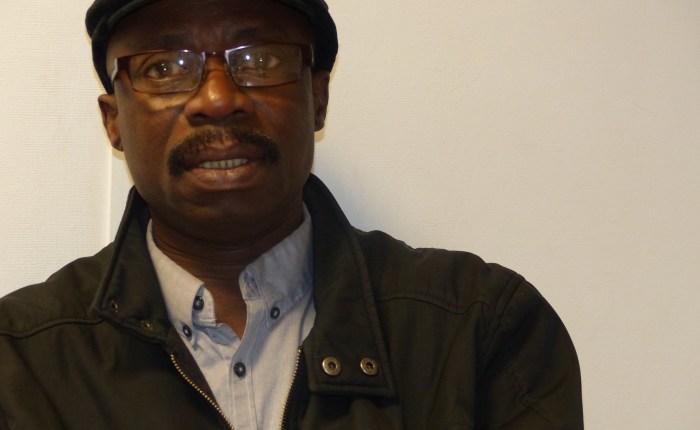
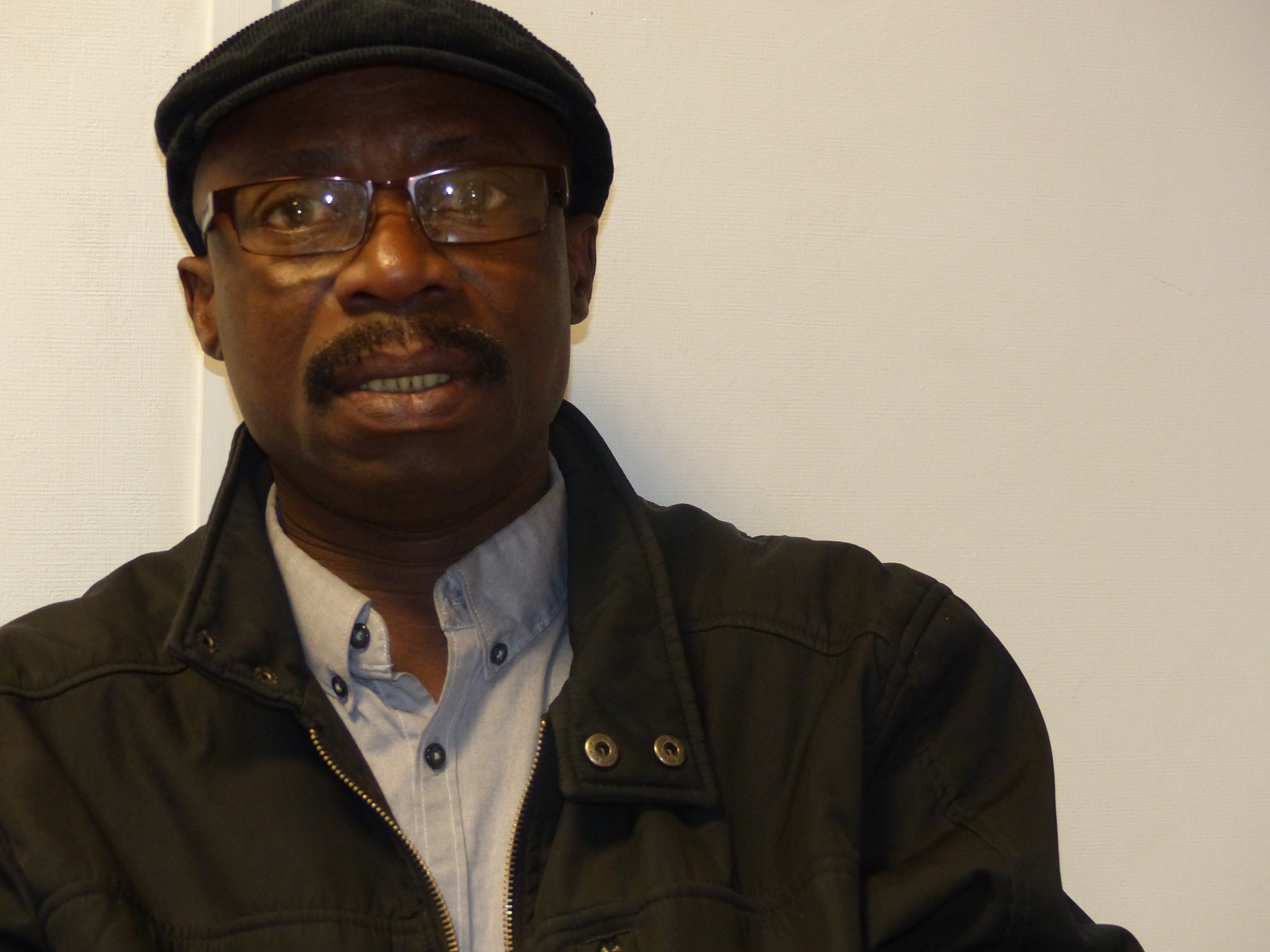
While they struggle on, Ben Adou (pictured above) came into the foodbank to share his story. Last week I mentioned that he brought along a foodbank voucher – his third. He couldn’t have survived without them, as he hasn’t received any jobseeker’s allowance (JSA) since March 7. This has plunged Ben – a widower of 56 whose wife died of cancer in 2012 – into a financial crisis. He claims housing benefit, has no savings and has nothing to fall back on. There is no safety net here. He came into the foodbank at what he somewhat ironically called lunchtime – hungry because he hadn’t been able to eat that morning. At least he was able to get some tea and a spare sandwich, and leave with his emergency pack of long-life food and some bread that had been donated that day. ‘You have brought me happiness by giving me food’, he said.

The problems started when Ben, who mostly works as a labourer, was offered a job through the controversial Universal Jobmatch scheme at the beginning of March. It turned out to be just two days of work, which he said had ‘completely messed up my JSA claim’. It’s also impacted on his ability to pay a contribution towards his rent, pay his council tax and to meet other household and phone bills. It has made it almost impossible for him to get to interviews. Crucially, of course, he can’t buy food. Any sort of a social life is totally out of the question, of course. With his JSA on hold, he now has no idea exactly when his benefit payments will resume. He called into the jobcentre to try to get to the bottom of things: ‘They said I was overpaid JSA during spells when I was working, and I disagree. They’ve put in writing that they know they owe me £431.60, but they’re saying that I owe them about £286.00 – and that this was a possible overpayment to me.’

The Government’s Universal Jobmatch website  – managed independently by private recruiter Monster – has come under much criticism. MP Frank Field said in a Guardian article, that it is ‘bedevilled with fraud’ and ‘out of control’.The Department for Work and Pensions (DWP) revealed in a letter to Field that more than 350,000 job adverts might breach the website’s terms and conditions , which specify that employers must advertise a real job, not use premium rate numbers, pay at least the minimum wage and not cost the applicant any money to start.

In the meantime, Universal Jobmatch keep on sending him texts calling him to jobs he can’t take up and job interviews he can’t attend – because he has absolutely no money to get there. A few weeks ago he passed two interviews for some work in central London, but couldn’t get the money together to travel up to the job. The day before he had been offered work starting yesterday in Morden, ‘but I had to say no because I couldn’t afford to travel there’. He has no money, so needs a job. He can’t get a properly paid job, because he has no money to get there. A week previously he had been called for a first interview for a commission-based job, then was offered an induction. It was only at that point that he found out he would have to use an Oyster card and put money on it himself to enable him to travel around London to sell products door-to-door. Needless to say, ‘this wasn’t explained at the team meeting’.

He explained to JobcentrePlus that he needed some money, but doesn’t seem to have been told that he could have been given money directly by them. There’s a fund for that sort of thing, you see. But no-one seems to be told about it. Every year in April, JobcentrePlus offices are given a budget to pay for Budgeting Loans.These are interest free loans for people on JSA and other benefits. Travelling expenses within the UK are included in the needs covered by such loans. This money comes out of the JobcentrePlus Social Fund budget.

Ben, like many of the people I meet, is dealing with this ghastly situation with tremendous resilience. But there’s only so long he can cope without long-term damage to his health and wellbeing. He is diabetic and he also has a heart problem. Kafkaesque doesn’t even begin to describe the ridiculous, complex hassles faced daily by a growing number of our most vulnerable citizens. This week we found out that committed campaigner and journalist Mike Sivier’s battle to get information on deceased former sickness benefits claimants released that is clearly in the public interest has been unsuccessful – so far. He wants an update on the number of sickness benefit claimants who have died, but a tribunal has upheld the Information Commissioner’s decision that his Freedom of Information request was ‘vexatious’. But the judge criticised both the information Commissioner and the DWP for the other reasons they put forward to prevent the death figures from being made public. From what seems to be emerging here in London, do we also now need to look more closely at the equivalent figures for people on JSA?

Tight budgets, poor diets, judgmental callers

Mark Bothwell, who's still waiting for his ESA claim to be processed.
Mark Bothwell, who’s still waiting for his ESA claim to be processed.

A discussion programme on the Nicky Campbell Radio 5 Live Breakfast show this week on whether a tight budget means a poor diet  prompted quite a few callers to make comments including, ‘it’s all down to organising yourself’ or ‘it’s due to a lack of education’. Here at the London food bank, the majority of the people who come here for help know exactly what they should be eating.  They know what a healthy diet looks like. They’re just desperate and hungry, and can’t often afford to buy items such as meat or many fresh vegetables. Or anything much at all. That’s why they’ve been given a voucher for the food bank by a frontline care professional such as a GP.

People on low in-work incomes  – for example those working two zero-hours contracts paid below the Living Wage and often at the National Minimum Wage to make ends meet – don’t have the money to buy much meat protein. They have to focus on keeping a roof over their heads, and trying to ensure they have the electricity or gas to cook with. Neither do they often have the luxury of  time or the mental and physical energy to plan, shop for, cook and serve nutritionally balanced meals. In London, they probably can’t afford to run a car – which makes doing a bulk shop  – very handy when you’re time poor – really hard. They might live on a large estate, without the great  range of shops on their doorsteps that would allow them to make easy price comparisons. There would probably be a chip shop though, that would at least feed their family cheaply. Once they do get some food in, many can’t spend a lot of time preparing it. Those who are short of money often prioritize feeding their kids rather than themselves.

As for those on UK benefit levels that have been described by the European Committee of Social Rights as ‘manifestly inadequate’ , the chances of them being able to avoid food poverty are patently not reflected by the facts.  This food bank is part of the  Trussell Trust network of 420 UK food banks, which fed 913.138 people in 2013-14. But using research by Eoin Clarke, the Trussell Trust represents under half the estimated emergency food providers in the UK. He has listed 960 emergency providers, including food banks. Why so many  – an exponential growth – if a poor diet is down to poor education or disorganised individuals?

What about those who are among the increasing numbers who simply are not getting even these internationally criticised levels of benefits through on time  – either because of  delays or sanctions? Mark, whose case has been covered before here, has a serious shoulder problem and is in terrible pain. His arm is in a sling. He’s on jobseeker’s allowance (JSA) of £72.40 a week, and has applied for employment and support allowance (ESA). He put his claim for to this higher (but not that much higher) level of support about 10 weeks ago. He’s still waiting for his claim to be processed. Meanwhile, he’s trying to eke out what he describes as an existence.  Yes, most of the time he sees it as an existence rather than a fulfilling life. He told me: ‘The other day I was so bored I walked to Dartford and back. It took me nearly three hours each way – stopping every so often to rest. It was just to get me out of the flat.’

Unexpected bills  throw him off his budget, and this is what forced him to call into the food bank for a cup of tea and to see if we had any fresh food (sometimes people donate food that has to be given out on the day, or there’s some tinned food that is still in date but that can’t be included in the packs given out to those with vouchers). A direct debit he didn’t have quite enough funds for was returned twice to his bank, and the bank charged him £8 each time. This loss of £16 would have been the money he spent on food. Mark, who has to ensure he eats when he takes his strong painkillers a couple of times each day, said he had an appointment with his GP the next day, who would hopefully gave him a food bank voucher. So he would have to go to the only food bank open on a Saturday, and haul the bags home using his one good arm. He wouldn’t have got the bus, because he can’t afford it.

I’m coming across more and more people at the food bank who are even worse off than Mark if that’s possible. One client – Ben – a widower of 58 who came into the food bank hungry yesterday, is actually destitute . This is because his JSA was put on hold in early March, around the time the work he was offered through the controversial Universal Jobmatch system finished after two days – and he’s received nothing from the Department for Work and Pensions (DWP) since then. I’ll be detailing his case next.

Welcome to the UK in 2014. We should be proud of the way we treat our most vulnerable. The President of the UK Faculty of Public Health Professor John Ashton has written – along with John Middleton and Tim Lang – an open letter to Prime Minister David Cameron on food poverty in the UK. In the letter to the Lancet on behalf of 170 signatories, he mentions the ‘worrying gap in health circumstances and outcomes between rich and poor people in the UK.’ He says UK food prices have ‘risen by 12 per cent in real terms since 2007, returning the cost of food relative to other goods to that in the 1990s’. He notes that in the same period, UK workers have suffered a 7.6 per cent fall in real wages.  He adds: ‘It therefore seems likely that increasing numbers of people on low wages are not earning enough money to meet their most basic nutritional needs to maintain a healthy diet. We should not accept this situation in the UK, the world’s sixth largest economy and the third largest in Europe.’ He says that during the past five years, ‘food has been one of the three top factors in price inflation, sufficient to worry even higher-income consumers’. This inflation, he continues, ‘ has translated into families cutting back on fresh fruit and vegetables and buying cheap, sweet, fatty, salty, or processed foods that need little cooking’. A ‘vicious circle’ is set in motion, with poorer people ‘having worse diets and contributing to the worrying rise in obesity, diabetes and other dietary-related diseases’.

As Professor Ashton states so clearly to the Prime Minister, even the higher-income consumers are seeing the effects of  inflation on their food budgets. There’s obviously an impact there, and it’s right that this aspect is highlighted. But are we fighting hard enough for people such as Ben, who spent yesterday morning hungry and don’t currently have any budget for food? Or for anything….


Rebecca’s story: Young Londoners’ lives are being ruined and relationships corrupted

Rebecca’s story: Young Londoners’ lives are being ruined and relationships corrupted
Rebecca is 22, and has a budget of less than £20 a month for food.

Rebecca (not her real name) has narrowly escaped eviction from a hostel. She tries to eat on less than £20 a month. That doesn’t work so well, so she called into this London food bank a few days ago for some support. This 22-year-old travels two to three hours each way by bus across London to work weekend shifts for a retailer, but only earns £56 a week. There’s no more work on offer there, so she has to stick with what she’s got. Her jobseeker’s allowance amounts to £2.57 a week. She’s glad she doesn’t have children, ‘because I’m struggling to feed myself, let alone kids’. Welcome to the wonderful neo-Dickensian world without prospects that we’ve created for a growing number of young adults in London.

Despite the frustration and drudgery she faces each day, this young woman is generous, thoughtful and enterprising. The resilience and dignity she displays in the face of scandalous adversity is impressive. Her first words when she was given her emergency supply of food, were: ‘When I get a proper job I’m going to donate food to the food bank. I know how it helps – even just to get a can of soup. For me, that lasts for two meals. The staff here are friendly and that makes me feel a lot better, especially after that uncomfortable feeling I get at the job centre.’

Rebecca lives in the same hostel as Sarah, a woman of 28. Sarah was given an eviction notice by the Changing Lives housing association, telling her to move out last Friday at the end of her two month probation period. The council and the housing association responded to Sarah’s account here. Rebecca says she was also given an eviction notice, telling her to leave on the same day – but that the housing association has now changed its mind. Rebecca says the evictions didn’t go ahead and that both of them have been told they can stay. At least both women have a roof over their heads now.

She had to move away from the part of London she was living and working in and move to this borough. Here, she was given a place in the hostel. The council is paying for her housing while she’s there, but Rebecca has to find the hostel’s separate £60 a month service charge. She also spends £40 on her travel to work each month, has a £45 bill for her mobile phone, and repays debts of £40 a month. She’s been told by a party plan company that she must pay for left-over kit it supplied to her. The Department for Work and Pensions (DWP) has also been deducting payments from her JSA for money it says she owed . ‘The DWP said I owed them £200 from when I was claiming JSA four years ago – it was only for a two month period. I don’t know if I’ve paid it off now.’

The little that’s left over goes on everything elase, including food. What she does to survive is to spend £5 a week on vegetables to turn into soup that last days. She misses being able to buy meat, because it’s so expensive. Now and again she can buy chicken.

What does she think about her situation? ‘I can’t afford clothes or any luxuries. I’ve been applying for jobs constantly, but I’ve never been able to get a full-time job. I love working where I am – both the customers coming into the store and my colleagues, so I’ve decided that until I get a (full-time) job, I will keep this going. I went on benefits when I was 16 and started a part-time job at 19. But as soon as I got a full-time job they cut my hours down and said they couldn’t afford to keep me. It’s not work’s fault they don’t have enough hours. I really enjoy my work.’

All she wants to do is work, but she feels self esteem issues may also now be holding her back. ‘I hate people thinking I’m not trying hard enough. When you’re having confidence issues it’s harder to get jobs. Recently I was told I was suitable for a job, but because I’m not confident enough I wasn’t getting it.’

She says that as soon as she finds a job she’s going to get somewhere else to live straight away. The worse thing, she says, is ‘feeling like I have to rely on other people – at the age of 22 I don’t want to do that’. The way society treats the young also pollutes their closest relationships with parents and partners. She says that her boyfriend, ‘thinks I rely on him for everything, and I don’t.’ She adds: ‘He says he doesn’t want to live with me, because he doesn’t think I can finance myself. I haven’t told him I go to the food bank. He doesn’t even understand why I go to the job centre.’ Her situation is obviously taking its toll on their relationship.

Rebecca says she had more money to live on before, when she was 16. ‘Back then I went to college, got income support, and had housing benefit.’

Guardian writer Hannah Fearn wrote recently about the campaign led by Citizen’s Income Trust and Basic Income UK to replace the ‘costly, complex benefits system’, with a citizen’s income – an ‘unconditional payment granted to every individual as a right of citizenship’. The proposal is to set it below the minumum wage, but would give a basic income of £7,000 (more for pensioner and those with severe disabilities). The idea is gaining support with key figures, including Labour MP John McDonnell. The article says that when a pilot project funded by Unicef in eight villages in India introduced a basic income, the outcome was that work increased. The article adds: ‘The cash in pockets led to small scale investments, such as the creation of new businesses, and women gained more than men.’

Hannah Fearn points out that the principle of means testing – ‘that we should only get something from the state if we prove we definitely need it – stands intact and unscrutinised with politicians simply tinkering with the goalposts’. Could the principle of a citizen’s income be a way to transform the currently dismal outcomes for Rebecca and her struggling generation, and bring some real equity, and a degree of vital autonomy?