Bone marrow transplant patient could lose her Motability car under DWP rules

“Lesley” is petrified. She needs a bone marrow transplant at the end of this month. Trying to deal with Myelodysplasia – a serious blood disorder that causes a drop in the number of healthy blood cells – is tough enough already, and she is very anxious about the transplant. But now she’s worried she’ll lose her Motability vehicle at the very time she needs it most. The decision by the Department for Work and Pensions (DWP) to stop paying the mobility component of the Disability Living Allowance (DLA) or Personal Independence Payment (PIP) to the Motability Scheme when people end up in hospital for more than 28 days has added an extra level of concern.

The 47-year-old divorcee depends on the leased car for her 40-mile round trip to the NHS centre of excellence where she’s being treated. She expects to be in hospital for four to six weeks post-transplant. She has also been told by the hospital that she could be in again after that frequently as an inpatient and will have three visits a week as an outpatient. She’s advised that using public transport poses an infection risk post-transplant. She is unable to rely on family and friends who are at work for lifts, and can’t afford taxis.

The DWP tells people in receipt of DLA to let them know when they first go into hospital, and to tell them once they are discharged. They are then told to supply details of any subsequent inpatient stays. But “Lesley” says this just “adds to the stress when I just want to move on with my life – they are just putting obstacles in my way”.

She says Motability has been sympathetic to her circumstances and has said she can keep the car for a couple of months if DWP payments to Motability on her behalf are cancelled. But with the prospect of being in and out of hospital on the horizon for some time, she’s concerned that a possible pattern of stop-start payments may not be triggered quickly enough to ensure that the car is available when she desperately needs it. She believes that those with the most serious illnesses who have to spend longer in hospital risk losing out most under this change, which began in April 2013. “If I wasn’t very ill I would continue to get it (the mobility component), but because I am very ill, I don’t get it. In all the literature I am advised to not use public transport due to infection risk. How then would I get to hospital?”

Following the transplant her immune system is going to be “wiped out completely”. “If I travel (on public transport) with someone with a cold and I catch it, that would be extremely bad news – really dangerous. Getting public transport could effectively kill me yet I may be left with no choice. I have had to think long and hard about this transplant. All my family and friends work and I’m single, so cannot rely on others. It’s scaring me as it’s a dangerous procedure anyway and then I could catch a cold virus or infection from someone and die because I don’t have my own clean safe transport. The decision to change the rules in 2013 was a ludicrous one. Also I wasn’t warned about it when I started the car scheme. Suspending and reinstating the mobility component must cost a fortune in administration.”

There are two organisations which work closely together to deliver the Motability Scheme. They are Motability, a registered charity, responsible for oversight and Scheme policy, and Motability Operations Ltd, a not-for-profit private company that operates the Scheme under contract to Motability. A spokesman for Motability said in a statement: “To lease a car, scooter or powered wheelchair through the Motability Scheme, an individual must be in receipt of the Higher Rate Mobility Component of the DLA, or the Enhanced Rate of the Mobility Component of PIP. Motability has no role in determining who should receive disability benefits – that is solely the responsibility of the Department for Work and Pensions (DWP). In general, the DWP do not make payments of DLA care and mobility components after a disabled person has been in hospital for 28 days or more (84 days for children under 16). Payments resume once the disabled person comes out of hospital. From April 2013 onwards, the DWP has started to treat all hospital inpatients in the same way, whether they have a Motability vehicle or not. This means that if a customer spends more than 28 days in hospital, the DWP will stop paying the mobility component of the DLA/PIP to the Motability Scheme.”

The statement adds: “As soon as customers are admitted to hospital, they should notify the DWP of their change in circumstance. For hospital stays of more than 28 days, they or somebody acting on their behalf should contact Motability’s Customer Services Team on 0300 456 4566 to discuss their individual circumstances. Depending on the expected length of their hospital stay and, of course, their own preferences, we will discuss appropriate arrangements with them. Since this change was made by the DWP in April 2013, we have been contacted by a number of customers in this situation and have been able to leave cars with them in the expectation that they will come out of hospital and have their allowance reinstated by the DWP within a reasonable period.”

The DWP was approached for information about the cost of administering the change and the savings made since the change was implemented. It was asked how many disabled people had been affected after stays in hospital and if any cost/benefit analysis had been undertaken prior to the change. It was also asked if any challenges or complaints had been received, and whether there was a legislative basis for the change. No reply has been received to date.

Motability’s flexible and understanding approach to individuals affected by this change is admirable – but what happens if the person is unfortunate enough to need a series of extended hospital stays and the DWP isn’t paying for the car? The uncertainty involved isn’t making “Lesley’s” life any less stressful. Also, for how long will Motability continue take the financial hit as it strives to do the right thing?


Mark unravels after sanctions: “The process left me feeling suicidal.”

Mark unravels after sanctions: “The process left me feeling suicidal.”
Mark Bothwell is now recovering from his sanctions trauma

According to Vox Political  and the Disability News Service, the UK government seems to have become the first country to face a high-level inquiry by the United Nation’s Committee on the Rights of Persons With Disabilities (CRPD). The committee has the power to do this if it receives what it calls “reliable information of grave or systemic violations” of the rights of disabled people by a country signed up to the UN Convention on the Rights of Persons with Disabilities (UNCRPD) and its optional protocol.

The committee conducts its investigations “confidentially”, so it has refused to confirm or deny that the UK is being investigated. Disability News Service has reported that CRPD appeared to have put off its public examination of the UK’s approach to implementing the disability convention until after next year’s general election. According to Vox Political, it now appears that the committee “may have taken this decision because it had launched the much more serious – and so far unprecedented – inquiry into the UK’s violation of disabled people’s rights”.

Surely here in the UK we wouldn’t abuse disabled people? Could that really happen in London, for example – a sophisticated and rich world capital, recently revealed by an article in Forbes as the world’s “most influential global city”. London was ranked first in the world on the Z/Yen Group’s 2013 Global Financial Centres Index. The article admiringly states that “its location outside the United States and the eurozone keeps it away from unfriendly regulators”, and it’s a “preferred domicile for the global rich”. Given all that serendipity and wealth, the world’s most influential city must also be in a position to influence things to ensure its residents don’t starve?

The benefits of London’s position as a welcoming home for the world’s rich don’t appear to be improving matters for the clients at the food bank frontline in London – or nationally for that matter. Greenwich food bank (which is currently operating from seven locations across the borough) has seen visitors increasing from 776 to 5025 in the past year. In nearby Lewisham, the figure rose from 623 to 3895. Mananger of the Greenwich food banks Alan Robinson tracks the increase he’s seen to welfare changes dating from April 2013, including the bedroom tax and welfare cap.

A few days ago I caught up with long-standing Greenwich food bank client Mark Bothwell, who has depression and whose shoulder injury had developed into a chronic problem. I’ve interviewed Mark many times, and he’s a warm, intelligent and engaging young man of 29. His experiences must make him one of those said to be experiencing diabolical treatment – those “grave violations” – at the hands of the Department for Work and Pensions (DWP) over many, many months. Mark told me that by July he was so distraught that he felt  suicidal.

Despite having already waited  for a prolonged period on jobseeker’s allowance (JSA) while believing that his claim for employment and support allowance (ESA) was being assessed, Mark was not only told that his ESA paperwork had been lost, but that he had been sanctioned – twice – for supposedly failing turn up for jobseeker advice appointments with Greenwich Local Labour and Business (GLLaB). He was told that he’d received the first sanction stopping his JSA at the end of May and that they had written to him telling him about the appointment. He says he did not receive any such letter. He began an appeals process with the help of Greenwich borough’s Welfare Rights Service. While he was told that the appeal for this sanction was being allowed, he was informed “in the same sentence that I was not going to get any money, because there was a second sanction for the same period of time for another missed appointment that I didn’t know about”. He says they told him they had sent another letter – “but I didn’t receive them”.

When the initial sanction was imposed, Mark was plunged into a nightmare of making multiple phone calls to different people in an attempt to get some help. It took two weeks to get a DWP hardship payment (about 40 per cent of normal JSA) through, and this was not enough to cover his bills – ” I had to borrow money”. He had to make multiple calls to the JSA enquiry line on his landline. He was told that if he wanted to talk to a “decision maker” he would have to call the enquiry line and leave a message for the “decision maker”, who would then call him back. He says that “on almost every phone call he was told something different”.

He added: “From about the beginning of June until mid-July I made about 60 phone calls trying to sort out the appeals and the (lost) ESA (claim). I had to resubmit the application for ESA because they said they lost it. On almost every phone call I’d be told something different. That process left me feeling suicidal. They were telling me a different thing every single time. They would tell me it (my money) would be a week, then I phoned up and they said no they shouldn’t have told you that. Then with the last phone call the woman said, no it doesn’t happen like that, it takes another two weeks. She was so rude I just hung up and collapsed on the floor. Tears were running down my face. I actually said out loud the word suicide to my flatmate, to my family and to complete strangers. I hit rock bottom around July 10-12.”

About a week later, Mark was told that he would get ESA, and that it would be backdated from the end of May. He is now receiving £144.80 a fortnight. The regular money is “helping a lot” and he says he can now buy food items such as fresh meat. He’s certainly looking brighter and stronger now.  Mark shares a home with a disabled flatmate and friend. This person has been told he’ll be getting a Personal Independence Payment (PIP) for help with some of the extra costs of being disabled. With the PIP finally in place, Mark has at last been able to fill in the application form for Carer’s Allowance in relation to the help he gives his friend. He’s also finally getting better help for his depression, and has been able to come off his Tramadol medication, which was beginning to badly affect his short-term memory.

Finally, after this atrocious wait and a host of adverse developments, Mark is starting to get the benefits he’s entitled to. But why did the state allow him to languish for such a long time waiting to move from JSA to ESA, and without Carer’s Allowance? Mark began experiencing problems with his shoulder last October, and in May, I reported that he’d already been waiting months for his ESA claim to be processed. In respect of his friend’s PIP application, we know that PIP claim backlogs during the first year of its introduction have caused tremendous problems for the disabled.

During his time without benefits because of the sanctions, Mark had to survive for two days without any food. As a long-standing client of Greenwich food bank, Mark has been provided with the usual three days’ supply of nutritionally-balanced non-perishable food on about a dozen occasions. Greenwich food bank is part of the Trussell Trust network of food banks. Its policy and commitment is to provide short-term help through a crisis for people who’ve been referred by a frontline professional such as a social worker or health visitor. The decision was taken not to provide another food parcel. This happened after careful discussion and review. The Trussell Trust believes that providing food aid on multiple occasions for an individual can remove an essential incentive to fix the underlying problems that drive people to the food bank in the first place.

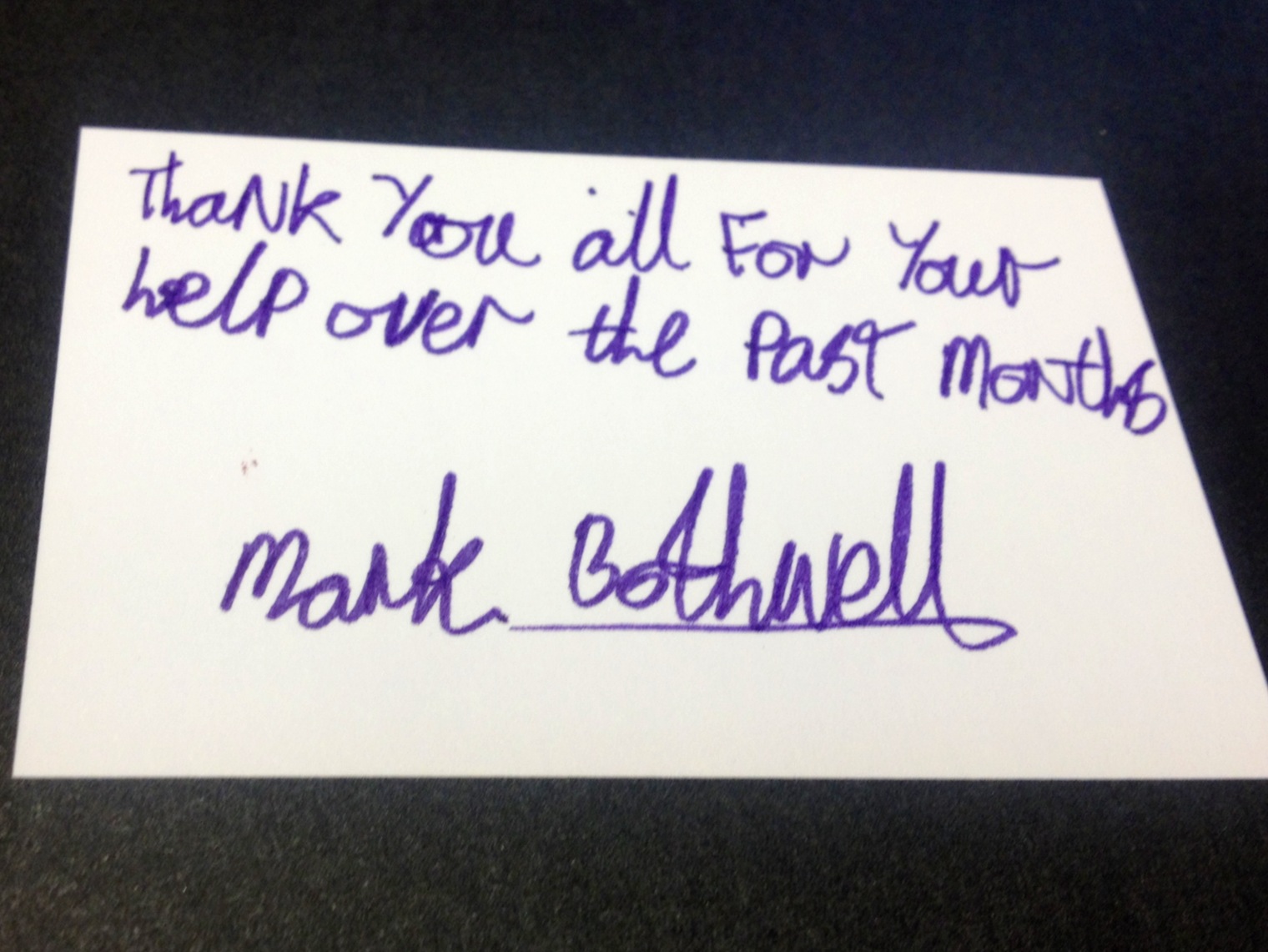
Mark has been very appreciative of the support he’s received from the food bank over the last number of months. Very thoughtfully, once his ESA money came through he brought in a cake and a thank-you card – to the delight of the volunteers.

Mark shows his appreciation for the food bank's help
Mark shows his appreciation for the food bank’s help

In July, a report – Dignity and Opportunity for All: Securing the Rights of Disabled People in the Austerity Era – was published by the Just Fair consortium, which included Disabled People Against Cuts and Inclusion London. it suggests the UK had moved from being an international disability rights leader to risking becoming a “systematic violator of these same rights”. Many of the individual accounts I’ve collected here, including Mark’s, add to the evidence that the vulnerable and disabled are the subject of the gravest injustices.

The benefits support worker: The £6.31 minimum wage is not enough to live on

Returning to the work being done at King’s Church in Catford this week,  I talked to Andy, who is a  paid support worker. This church in South-East London sees social action and reaching out to the community as a priority.

He reports that since the most recent changes in welfare benefits, most of his work has involved giving benefits advice. “The changes might not affect everyone, but they have hit most of the group we work with particularly hard. Some of them are from very disadvantaged backgrounds. There’s been a demise in manual work, and the £6.31 minimum hourly rate is not enough to live on, even with housing benefit – and that’s if they’re lucky enough to work.”  London, for those on minimum wage or no wage is not a city where you can live with dignity. This minimum wage is of course set far below the new London Living Wage rate of £8.80 an hour that employers can opt to sign up to.

As for schemes such as Universal Jobmatch – which claims to match jobseekers with vacancies – Andy says he has “never known anyone from that scheme who’s had even a reply (about a vacancy) through it”. He says he challenged someone from the Department for Work and Pensions (DWP)  on this. “I was then told they were very fussy about people’s CVs.”

Sanctioning people on benefits has a detrimental impact on them, he says: “If jobseeker’s allowance (JSA) is stopped, housing benefit is automatically stopped, and they often need support to get their housing benefit reinstated.”

One of Andy’s key roles is to act as an advocate at tribunals for people who are challenging Atos (one of the private companies administering fit-for-work tests) decisions to refuse them employment and support allowance (ESA) – the higher rate of benefit that takes into account their inability to work because of ill health. Andy tells me he only represents people at tribunal if he’s convinced they’re not fit for work. “If people don’t get enough points, they don’t get the benefits and they don’t have the confidence to take matters forwards themselves. You have to feel you deserve it.”

The issue for many of those he comes across it that they lack the self-esteem to take on the system themselves. He adds: “I think there’s a section of society that has low self-confidence, and often have mental health issues without a formal diagnosis.”

His success rate at tribunal is very high. He hasn’t taken anyone there who hasn’t ended up with a minimum of 15 points, and some of them score higher than this. These are people who have scored “maybe nothing or a few points in the Atos assessment”.  It goes without saying that he thinks the Atos assessment process is obviously not working.

In March this year it was announced that the £500 million contract with Atos, mired in accusations that the tests they applied were inhumane and crude, would end early. Judge Robert Martin, the departing head of the tribunal which hears appeals, was reported in the Guardian here as saying that the work capability assessment (WCA) process has undergone “virtual collapse”. In a confidential journal distributed to tribunal members, he said that this collapse was the biggest single factor in the decline in the numbers going to appeal.

He added in the article that the removal of funding under the legal aid scheme for advice and assistance on welfare rights matters, “compounded by continuing cutbacks in local authority spending on advice services has severely reduced the help and support available to claimants to pursue their legal rights in challenging benefits decisions”. Judge Martin says that if a supplier to replace Atos is found “presumably at a premium, the company will have to address the chronic shortages of healthcare professionals which has dogged Atos and which is exacerbated by the need for additional resources to deal concurrently with PIP (the personal independence payment introduced to replace disability living allowance over a three-year period beginning last October)”.

Given the difficulties facing those who want to challenge benefits decisions, the people who end up with Andy on their sides are the lucky ones. Andy is an expert and they’ll usually win their case. But there aren’t enough people around like him now – committed inviduals with the benefits know-how to successfully take on the DWP. Legal aid lawyers and welfare rights experts are a dying breed in the UK.

All the signs are there that the outlook for this most vulnerable group can only get worse. The majority of the spending cuts deemed crucial to the austerity narrative lie ahead and are set to bite even deeper into welfare spending. Chancellor George Osborne said in what the Guardian called a “grim New Year’s message” in January that the biggest chunk of savings of around £12bn will come from welfare in the two years after the election, with young people and those of working age most at risk from cuts.