Deborah, her ATOS debacle, and the missing coat mystery

Deborah, her ATOS debacle, and the missing coat mystery

Deborah Ruby, who had her ESA stopped, despite her multiple chronic health issues.
Deborah Ruby, who has had her ESA stopped, despite her multiple chronic health issues.
Deborah Ruby struggled into this London Trussell Trust food bank with her voucher. She’s a 51-year-old lady with multiple health issues. These include, but are not limited to, arthritis in the lower spine, hips, neck and knees, depression, severe Irritable Bowel Syndrome and congenital heart problems. She has been separated from her husband for 12 years and has four children – the youngest of whom is still at school.

A social worker gave her a voucher for the food bank after her employment and support allowance (ESA) was stopped on July 25. This stoppage followed her ATOS work capability assessment in June. Atos Healthcare is of course making an early exit from its contract to carry out “fit for work” tests on disability claimants. If Deborah’s experience is typical, the ATOS assessment process is if possible leading to ever more unfair outcomes for individuals. She describes the worst sort of bureaucratic bungling, and a medical report that appears to bear little resemblance to Deborah’s account of the ATOS medical interview it was based on.

Given what Deborah says happened at the medical, it’s hard to see how she wouldn’t succeed in her appeal. But the likelihood of a successful appeal at some future date isn’t any consolation to someone in her position. For nearly eight weeks she’s had no ESA and no money for food. Her sister – the only sibling who could help – had been able to offer some assistance over the summer. But now she’s had to go back to her home outside the UK. So last week Deborah hit a full-blown crisis – and has no idea if or when she will receive any benefits again. Now that her ESA has been stopped, her housing benefit has also been stopped – pushing her into arrears.

Deborah says she brought along a letter from her doctor to the Croydon medical, describing all her medical conditions. She says that at the medical, she was having so much difficulty moving around – she needs two knee replacement operations – that the doctor had to help her on and off the couch. She was in pain throughout the assessment.

The letter that followed informing her of the decision and the medical report was both contradictory and wrong, says Deborah. While there was a statement at the top of the letter from the Department for Work and Pensions saying that she would be receiving an award and that they would write to her in due course, the assessment and medical report contained in the correspondence told her that she had failed the medical and had in fact been given zero points. She would have needed 15 points to keep her ESA award. According to Deborah, “the report said she could get on and off the couch and she was not in pain, and it said I had no problems putting on my coat myself – but I didn’t have a coat with me. The assessment referred to my depression and other illnesses with the exception of fibromyalgia – but they feel that I’m fit for work. It referred to my incontinence, and she (the doctor) acknowledged that, but said that I can still go out. It seems that in the report they put down the things they wanted to put. The doctor’s report also says ‘she was well enough that she made it here’ and I feel she glossed over and downplayed everything.”

Though initially confused about the contradictory letter, Deborah said that when a follow-up letter did not arrive within a few days, she then sent back a copy of the assessment form as part of an appeal, indicating where she disagreed with the doctor’s assessment. The DWP sent a letter back saying that it had read her challenge, but that it agreed with the ATOS decision. It told her to apply for jobseeker’s allowance (JSA). She has been back to her GP to get medical certificates saying that she cannot attend work-related programmes or work because of her health, and an NHS psychologist is also liaising with her GP ahead of the appeal. Meanwhile, Deborah is having to deal with letters from the council about her stopped housing benefits.

While it at least appears as if she has got past the reconsideration stages and lodged an appeal successfully, she has no idea when it might be heard and has been left stranded with no support while she waits.

According to the latest tribunal statistics, there has been a drop of 92% in employment and support allowance (ESA) appeals and a 93% drop in Jobseekers Allowance (JSA) appeals in April to June 2014 compared to the same period last year. A new system of mandatory reconsiderations before appeals was introduced by the DWP for ESA and JSA at the end of October 2013. Figures have yet to be published by the DWP to show how many reconsiderations result in a change of decision.

We do of course need to know much much more about the people who don’t get as far as an appeal. Precisely how many people are left destitute or dead because they’ve abandoned – or been abandoned by – the system at this most tortuous stage?


The state owes citizens money they are entitled to – then they fall into debt

Manager of Greenwich food bank Alan Robinson has been aware for some time that the clients who come here for help need more than the food they’re given to see them through an immediate crisis. They also require longer-term support to tackle the underlying problems, which often include inadequate incomes and unmanageable debts. The local authority – The Royal Borough of Greenwich – is also mindful of this. The two organisations have submitted a bid for funding that would enable the food bank to “triage” clients with money problems.

If the joint bid is successful, the funding would come from the Money Advice Trust – which has today launched a new report saying that households are becoming susceptible to serious debt problems because they can’t afford basic household bills.

Alan said: “The Money Advice Trust is offering funding for initiatives that are innovative, but help meet people’s basic needs…approaches that would help them get relief from debt and educate people so they don’t get into debt. Greenwich Council had been bouncing this problem around internally, so they called me up and said could we work together and get a bid in.” The initial “triage” would take place at the borough’s food banks, which are part of the UK-wide network of Trussell Trust food banks. Clients with the most severe problems would be immediately referred to specialist debt advisors in the borough – either Christians Against Poverty (CAP), Meridian Money Advice, or Citizens Advice.

A second group assessed as heading for serious debt problems would get advice from trained volunteers, and Alan says the food bank may also employ a debt and advice specialist. A third group of people with the least severe problems would get help and encouragement on a range of issues, including advice on cookery classes, “smart” shopping and smoking cessation. The gateway to the advice would be food banks, but Alan says it’s possible that the scheme could be extended to other venues including children’s centres. The proposed scheme mirrors a recent announcement by the Trussell Trust that it is to launch a pilot scheme to give financial advice. The move comes after the food bank charity received a six-figure donation from money saving expert Martin Lewis. Lewis is quoted in the Guardian saying: “Those who go to food banks are already open to asking for help….If we can intervene at that point…it will hopefully cut down on the number of return visits.”

While what Lewis says is undoubtedly true, it’s crucial to remember what the Trussell Trust itself underlined in its June report Below the Breadline: The Relentless Rise in Food Poverty, published jointly with Oxfam and Church Action on Poverty. The report says that “cuts to social security since April 2013 have had a severe impact on poor and vulnerable families across the UK” and that “these cuts have been coupled with an increasingly strict and often misapplied sanctions regime – 58 per cent of sanction decisions are successfully challenged, suggesting that many people needlessly suffer a loss of income through no fault of their own”.

The report says the abolition of the Social Fund has stopped thousands of households from being able to access crisis loans. The Trussell Trust, “estimates that 49 per cent of people referred to food banks are there due to problems with social security payments or because they have been refused a crisis loan”.

The move by the Trussell Trust to launch the pilot money advice scheme and the bid to run something similar here in Greenwich are to be welcomed. But expert social security advice and help with challenging sanctions and speeding up back payments appear to be what clients need most. In essence, the state owes them money that they are entitled to. They’re not getting it, hence they are in debt and that leads to them not being able to pay their water bill or council tax. The most effective cure would of course be a humane social security regime, and an approach to sanctions that is fair and proportionate. A move away from zero hours contracts by employers would also be a significant move to transform lives. The problems faced by most of the people who visit the food bank are not fundamentally caused by lifestyle issues or bad choices. The vast majority of the food bank clients are innocent victims of an increasingly unfair and cruel welfare system.

Mark unravels after sanctions: “The process left me feeling suicidal.”

Mark unravels after sanctions: “The process left me feeling suicidal.”
Mark Bothwell is now recovering from his sanctions trauma

According to Vox Political  and the Disability News Service, the UK government seems to have become the first country to face a high-level inquiry by the United Nation’s Committee on the Rights of Persons With Disabilities (CRPD). The committee has the power to do this if it receives what it calls “reliable information of grave or systemic violations” of the rights of disabled people by a country signed up to the UN Convention on the Rights of Persons with Disabilities (UNCRPD) and its optional protocol.

The committee conducts its investigations “confidentially”, so it has refused to confirm or deny that the UK is being investigated. Disability News Service has reported that CRPD appeared to have put off its public examination of the UK’s approach to implementing the disability convention until after next year’s general election. According to Vox Political, it now appears that the committee “may have taken this decision because it had launched the much more serious – and so far unprecedented – inquiry into the UK’s violation of disabled people’s rights”.

Surely here in the UK we wouldn’t abuse disabled people? Could that really happen in London, for example – a sophisticated and rich world capital, recently revealed by an article in Forbes as the world’s “most influential global city”. London was ranked first in the world on the Z/Yen Group’s 2013 Global Financial Centres Index. The article admiringly states that “its location outside the United States and the eurozone keeps it away from unfriendly regulators”, and it’s a “preferred domicile for the global rich”. Given all that serendipity and wealth, the world’s most influential city must also be in a position to influence things to ensure its residents don’t starve?

The benefits of London’s position as a welcoming home for the world’s rich don’t appear to be improving matters for the clients at the food bank frontline in London – or nationally for that matter. Greenwich food bank (which is currently operating from seven locations across the borough) has seen visitors increasing from 776 to 5025 in the past year. In nearby Lewisham, the figure rose from 623 to 3895. Mananger of the Greenwich food banks Alan Robinson tracks the increase he’s seen to welfare changes dating from April 2013, including the bedroom tax and welfare cap.

A few days ago I caught up with long-standing Greenwich food bank client Mark Bothwell, who has depression and whose shoulder injury had developed into a chronic problem. I’ve interviewed Mark many times, and he’s a warm, intelligent and engaging young man of 29. His experiences must make him one of those said to be experiencing diabolical treatment – those “grave violations” – at the hands of the Department for Work and Pensions (DWP) over many, many months. Mark told me that by July he was so distraught that he felt  suicidal.

Despite having already waited  for a prolonged period on jobseeker’s allowance (JSA) while believing that his claim for employment and support allowance (ESA) was being assessed, Mark was not only told that his ESA paperwork had been lost, but that he had been sanctioned – twice – for supposedly failing turn up for jobseeker advice appointments with Greenwich Local Labour and Business (GLLaB). He was told that he’d received the first sanction stopping his JSA at the end of May and that they had written to him telling him about the appointment. He says he did not receive any such letter. He began an appeals process with the help of Greenwich borough’s Welfare Rights Service. While he was told that the appeal for this sanction was being allowed, he was informed “in the same sentence that I was not going to get any money, because there was a second sanction for the same period of time for another missed appointment that I didn’t know about”. He says they told him they had sent another letter – “but I didn’t receive them”.

When the initial sanction was imposed, Mark was plunged into a nightmare of making multiple phone calls to different people in an attempt to get some help. It took two weeks to get a DWP hardship payment (about 40 per cent of normal JSA) through, and this was not enough to cover his bills – ” I had to borrow money”. He had to make multiple calls to the JSA enquiry line on his landline. He was told that if he wanted to talk to a “decision maker” he would have to call the enquiry line and leave a message for the “decision maker”, who would then call him back. He says that “on almost every phone call he was told something different”.

He added: “From about the beginning of June until mid-July I made about 60 phone calls trying to sort out the appeals and the (lost) ESA (claim). I had to resubmit the application for ESA because they said they lost it. On almost every phone call I’d be told something different. That process left me feeling suicidal. They were telling me a different thing every single time. They would tell me it (my money) would be a week, then I phoned up and they said no they shouldn’t have told you that. Then with the last phone call the woman said, no it doesn’t happen like that, it takes another two weeks. She was so rude I just hung up and collapsed on the floor. Tears were running down my face. I actually said out loud the word suicide to my flatmate, to my family and to complete strangers. I hit rock bottom around July 10-12.”

About a week later, Mark was told that he would get ESA, and that it would be backdated from the end of May. He is now receiving £144.80 a fortnight. The regular money is “helping a lot” and he says he can now buy food items such as fresh meat. He’s certainly looking brighter and stronger now.  Mark shares a home with a disabled flatmate and friend. This person has been told he’ll be getting a Personal Independence Payment (PIP) for help with some of the extra costs of being disabled. With the PIP finally in place, Mark has at last been able to fill in the application form for Carer’s Allowance in relation to the help he gives his friend. He’s also finally getting better help for his depression, and has been able to come off his Tramadol medication, which was beginning to badly affect his short-term memory.

Finally, after this atrocious wait and a host of adverse developments, Mark is starting to get the benefits he’s entitled to. But why did the state allow him to languish for such a long time waiting to move from JSA to ESA, and without Carer’s Allowance? Mark began experiencing problems with his shoulder last October, and in May, I reported that he’d already been waiting months for his ESA claim to be processed. In respect of his friend’s PIP application, we know that PIP claim backlogs during the first year of its introduction have caused tremendous problems for the disabled.

During his time without benefits because of the sanctions, Mark had to survive for two days without any food. As a long-standing client of Greenwich food bank, Mark has been provided with the usual three days’ supply of nutritionally-balanced non-perishable food on about a dozen occasions. Greenwich food bank is part of the Trussell Trust network of food banks. Its policy and commitment is to provide short-term help through a crisis for people who’ve been referred by a frontline professional such as a social worker or health visitor. The decision was taken not to provide another food parcel. This happened after careful discussion and review. The Trussell Trust believes that providing food aid on multiple occasions for an individual can remove an essential incentive to fix the underlying problems that drive people to the food bank in the first place.

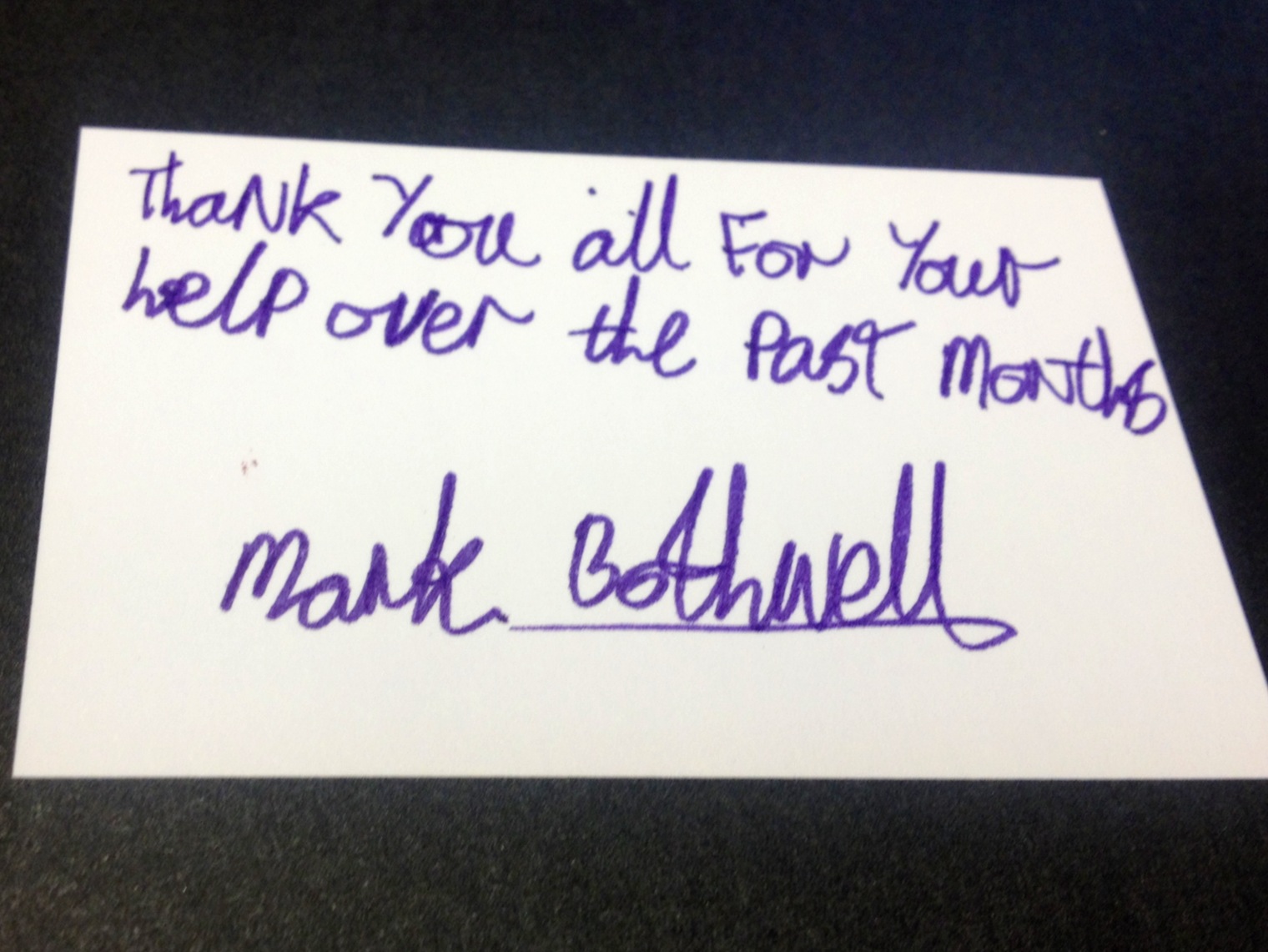
Mark has been very appreciative of the support he’s received from the food bank over the last number of months. Very thoughtfully, once his ESA money came through he brought in a cake and a thank-you card – to the delight of the volunteers.

Mark shows his appreciation for the food bank's help
Mark shows his appreciation for the food bank’s help

In July, a report – Dignity and Opportunity for All: Securing the Rights of Disabled People in the Austerity Era – was published by the Just Fair consortium, which included Disabled People Against Cuts and Inclusion London. it suggests the UK had moved from being an international disability rights leader to risking becoming a “systematic violator of these same rights”. Many of the individual accounts I’ve collected here, including Mark’s, add to the evidence that the vulnerable and disabled are the subject of the gravest injustices.