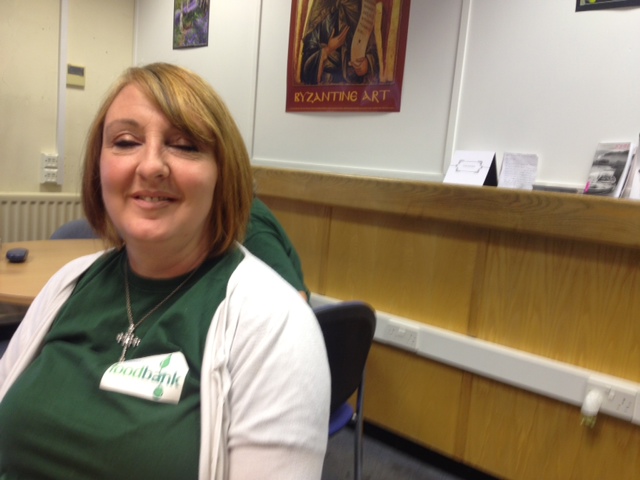
This is the story of food bank volunteer Debbie Angel and her feelings about both the work that she does and the clients who come to the food banks in this corner of London. Debbie (pictured left) greets the people who come in here, helps them to feel more at ease, and provides a listening ear as well as a crisis package of food to those in need.
They’re coming through her doors in increasing numbers. London may be the best city in the world to move to for work, according to a survey of over 200,000 people in 189 countries compiled by The Boston Consulting Group, recruiters The Network, and totaljobs.com. But for many of London’s existing residents – mainly those who are out of work, or on low incomes, or disabled and in ill-health – the city doesn’t seem nearly as attractive as this. It doesn’t seem quite the gleaming metropolis to the clients who arrive to see Debbie and the other volunteers each week.
When you take a closer look there’s a massive problem here and throughout the UK. The food banks here in the Royal Borough of Greenwich and across the UK come under the franchise of the Trussell Trust Network and the Trussell Trust’s statistics on food bank use are truly shocking. In 2013-14 913,138 people were given three days of emergency food and support, and the primary referral causes were benefit delays (31%) and low income (20%). In 2012-13 the figure was 346,992. But as the chairman of the Trussell Trust Chris Mould says – these figures are merely the ‘tip of the iceberg’. The charity has more than 420 food banks, but represents well under half of the total number of emergency food suppliers in the UK. A January 2014 report by Dr Eoin Clarke put the Trussell’s Trust’s share of the food bank sector at 43%.
When they reach the food banks here, people are desperate and at the end of a road. They can’t feed themselves or any dependents they may have.
If that happened to you, how would you feel about it? Maybe you’d be angry, depressed, frustrated or powerless? Would you feel somewhat bitter and resentful of others in this rich capital that people from all over the world seem to want to move to for work?
Well here’s the thing.
While people do want to share their experiences and explain the life circumstances that have led them here, people don’t tend to leave the food bank steeped in those emotions.
The accounts that people often share of their lives are ‘very heavy and very difficult’, says Debbie. But she believes that the common thread linking together the people she meets is gratitude and a desire to give something back to the organisation that has helped them through one of the hardest times in their lives. She says: ‘They are so grateful that we care about them. It’s the fact that you’ve listened to them. They encourage me as much as I encourage them. Giving them the food is the least of what happens. That’s the hardest thing for them to take away. Giving them some loving care and kindness and being here and hearing them speak is the important bit. They want to give things back when they are able.’
She adds: ‘This is not a one-sided thing – I love speaking to people here.’
I see people leaving with their heads held higher than when they came in, thanks to people such as Debbie.
Kestna Marsh is disabled. He was forced to the foodbank after a tribunal upheld a DWP decision to stop his benefit.
Kestna Marsh was 62 this week. At the moment he probably feels he has little cause for celebration.
This former construction worker struggles to walk as he has arthritis in his right knee, left leg and left shoulder. He can’t lift anything with his left arm. On the day he came into this London food bank with his voucher, his mobility was obviously restricted and he struggled with his walking stick to move from room to room. Because of his mobility issues I felt hesitant about asking him to move even a few steps into a quieter room. Kestna walked that distance because he wanted to share his experience of Work Capability Assessment (WCA).
He was left without the money to buy adequate food after a tribunal hearing at the beginning of last month (September) upheld the outcome of his 2013 face-to-face ATOS WCA. He attended the tribunal on his own, without the support of a legal or welfare expert, and there were two people on the panel – a doctor and a solicitor. The WCA awarded him zero points for his health issues, and Kestna immediately challenged this. But following the outcome of the appeal his employment and support allowance (ESA) claim was closed on September 13th. He thinks that as a result he ceased getting housing benefit on the same date. He now has to reapply for housing benefit. He’s been told by Jobcentre Plus to apply for Jobseeker’s Allowance (JSA), but he says he has been told by Jobcentre Plus that any claim for JSA wouldn’t be processed until October 17th.
He explains here how his health problems affect his life and how he feels about losing his tribunal appeal (apologies for the unconventional presentation of the video – camera operator in training!).
His Disability Living Allowance (DLA) of about £215 is paid monthly, but the payment in mid-September of about £50 a week has gone mainly on bills. What about food? “I’ve been eating salad, beans, cheese and the odd sandwich here and there. I can’t do a proper food shop. If you gave me stuff to cook my gas is more or less onto nil. I haven’t got a penny to my name.”
Kestna added: “They expect me to go back to work. They’ve told me that if another illness emerges then I can apply for ESA again. Since my original assessment (in 2013) my problems have got worse. I can’t use a computer and I can’t sit too much or walk too far for too long. What sort of job do they expect me to do? I previously worked in construction and I know that for me to sit in an office would require retraining.”
The serious difficulties he faces because of his obvious ill-health and the stopping of his ESA are compounded by his council housing situation and the difficulties in building up a relationship with a GP at his new surgery who can get to know him properly.
He lives on his own, and has recently moved from one part of the Royal Borough of Greenwich to another. He wanted to move to a ground floor flat, so he was offered one. But this new flat hasn’t been adapted to meet his mobility needs, so he is not entitled to the rent rebate that would accompany such an adaptation. He says that because the council moved him into a two bedroom flat instead of the one bedroom flat he wanted, the council has classed the flat as under-occupied. So because he’s been deemed as having an extra room, he’s having to pay an extra £12 a week towards the bedroom tax – for a flat that hasn’t even been adapted to meet his physical needs.
Kestna also says that there is apparently some discrepancy arising from his move from another flat in the borough, meaning that the council may have been paying him housing benefit for both flats. He also has council tax arrears of £112.
He left the food bank with contact details for welfare and housing rights experts.
He also left promising that he would make an appointment with his GP. “I’ve just moved into the area, so I don’t have a relationship with the GP yet. I must have had at least four or five appointments with different doctors.”
How did the tribunal decision leave him feeling? “I was really angry. I’ve never been through the food bank stuff. I always stuck to relying on my doctor. I got the certificate and sent it in on time. To find that they closed my claim without even informing me they were doing it, in my circumstances – I feel quite disgusted really.”
David Goddard spent four weeks sleeping on the floor at one of the three No Second Night Out hubs in London. The target length of stay is 72 hours.A few weeks ago I wrote about David Goddard, a young homeless man who was released from prison and spent a number of weeks in accommodation known as the hub in Lewisham, South East London. The hub is a place which takes in new rough sleepers, and is run by an organisation called No Second Night Out (NSNO). NSNO was set up in 2011 by Mayor of London Boris Johnson as part of an agenda to end rough sleeping in London by 2012. The Greater London Authority (GLA) pays for the stays. The idea is to stop the homeless spending a second night on the street and to prevent them becoming entrenched there. There are two other NSNO hubs in London providing emergency spaces for the homeless – in Islington and Shepherd’s Bush. NSNO describes these places as “an A&E for the homeless – a safe space”, and as a “staging area”.
David told me that in the past he had an issue with heroin addiction and had been forced to steal to survive. He got into trouble with the police and ended up in prison because of this. He said a few things about his NSNO hub accommodation that concerned me. He described a room containing about 25 people of both sexes, with people sleeping on the floor and chairs. He also said people as young as 16 or 17 had been there, and that he had been staying there for six weeks.
I needed to check all this out, because of the safeguarding issues potentially raised. To do this I spoke to Deputy Director of NSNO Dan Olney, who talked me through the project. He said: “NSNO is an emergency response to rough sleeping. Before we were around, an outreach worker would have approached someone on the street. It didn’t provide for that emergency need, and if they arranged to meet someone the next day it was difficult. Instead we have a hub rather than a hostel and the intended length of stay is 72 hours. The reality is there are cases where people stay there longer than that. It’s usually because we are trying to get an outcome via the local authority.”
When people overstay, “60 per cent of the time it’s because of a third-party – a mix of someone waiting for an appointment with the local authority, or for a response from a housing provider, or they’ve been assessed and are waiting for a housing vacancy”. NSNO “usually” expects the local authority to provide interim accommodation. “Quite often that depends on the client’s needs. A lot of our work is focused on trying to get people a service if they are entitled to it,” he added. David, he says, ended up in the unit for four weeks, rather than the six weeks he mentioned.
David told me that he was asked to leave after he got involved in a dispute with another person staying there. When I met him he had started squatting locally in an industrial unit.
Dan Olney said that if those taken into one of the three hubs had a link with another area (where they have spent three of the last five years), staff arrange to go with them to their “home” local authority and ask them to take on the case. But, “if they don’t meet the thresholds of priority need then there is guidance – but no legal obligation to meet their housing needs”. Of the 6,000 clients they’ve had since 2011, for the ones they recorded, 30 per cent had already approached their local authority for advice and assistance. For example, he told me that in the last quarter – January to March – 91 new rough sleepers had come to the borough of Westminster alone and had become clients of NSNO. But only two had a connection to Westminster. Many of them are EU nationals or from further afield.
So the aim is to do an assessment on each client within 72 hours and to then physically reconnect them to the place where they have a “home connection”. He says that NSNO “literally reconnects people worldwide, and it’s not just (giving them) a ticket – it’s working with the Home Office towards making them an offer”. What then about duty of care for the many clients who can’t be moved on within this time frame? “Security and safety is a big thing for us. We’re staffed 24 hours a day and we have to be very strict with people. If someone is presenting as a risk to people, then we give them a warning. If they’re demonstrating threatening behaviour or if someone is particularly vulnerable to a particular client group we would put them into a different part of the service.”
While the Greater London Authority pays for the stays having awarded the NSNO project a two-year contract, the project is actually run by St Mungo’s Broadway, which describes itself on its website as “a charity, a limited company and a housing association”. It says there that its aim is “helping people recover from the issues that create homelessness”. St Mungo’s Broadway employs the NSNO staff.
NSNO, said Dan, “manages safeguarding ourselves internally, and if we had a concern we would flag it up ourselves and contact the duty officer at local safeguarding services”. As well as a “risk management strategy for everyone in the hub, we have individual risk assessments”. He said the minimum age for someone staying in the hub is 18. “If they are 16 or 17 years old they would go straight to the local authority.”The hubs in Islington and Shepherd’s Bush have the option of separate accommodation for women. Dan said the hub in Lewisham is the staging post for people with lower needs. He added: “For people who have got higher needs we try to press the local authority to get them somewhere away from the hub. David would not have necessarily been acceptable for that, and a lot of time this is the reason for a long stay.”
He described NSNO as a project that is “rapid” at getting people off the streets, “but the systems that are in place around us are not always conducive to us meeting our targets”. Quite often, there’s a dispute with the local authority about whether it should be taking on a client. “It comes down to the person (from the local authority) who had done the assessment. We may think a person has a priority need, but the local authority assessment comes to a different conclusion.” The project is currently drawing up protocols with all local authorities in London, with the aim of ensuring the 72-hour time for dealing with clients is met. “The ethos is about trying to influence external partners to change the way they work to expedite the process to get people off the street,” said Dan. Some local authorities, in his view, are completely engaged with the process. Others, “particularly outer London boroughs – say we’re not having them back”.



 Ann McGauran