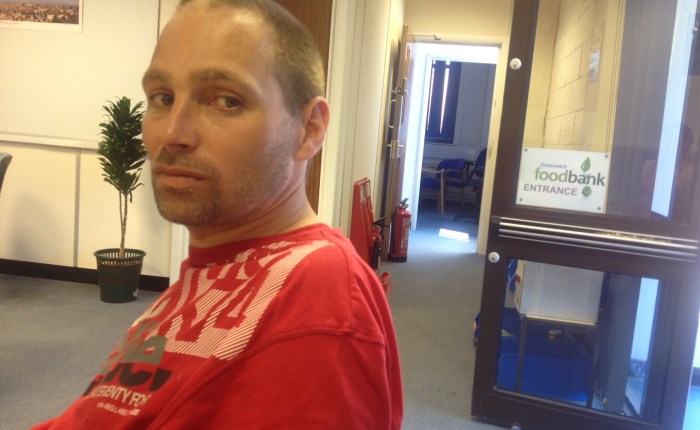
An exercise in hope: The Biscuit Fund steps to help Kevin after his benefits are sanctioned

An exercise in hope: The Biscuit Fund steps to help Kevin after his benefits are sanctioned
Kevin Jobbins, who's living on £7 a fortnight for food, following a benefit sanction
Kevin, who’s living on £7 a fortnight for food, is offered help from charity the Biscuit Fund

Something marvellous has happened! Those of you who’ve been following this blog for a while will know that the accounts people share of their lives – at the Greenwich food bank (part of the Trussell Trust network of food banks) and elsewhere – are often very grim. So I don’t get to use the word marvellous very often. There you go, I sneaked the word in again.

This week was different. There was some brilliant news for one of the food bank’s clients. A small charity called the Biscuit Fund was alerted via Twitter to my recent interview with Kevin .  It has now come forward  to offer Kevin some very well targeted and timely help.

He was left trying to exist on a food budget of £3.50 a week after he was sanctioned back in April while on employment and support allowance (ESA). He was told this was because he failed to arrive for an appointment with the Seetec job club. The reason  he didn’t make the appointment was because he had to look after his two-year-old son. The Biscuit Fund read the interview, and has been in touch with him. The charity has now agreed to send him a weekly food shop of fresh food for the next six weeks, and it will also pay his rent and council tax directly for the same amount of time.

Kevin, whose benefit payment went from £202 a fortnight to £47 because of the sanction, says he ended up begging and stealing for food because of the sanction. He has issues with drug and alcohol addiction. The 39-year-old is waiting to go into detox treatment and is awaiting surgery for a painful foot condition linked to his time as a homeless person. As far as I’m aware, the sanction is still in place this week, though I’m trying to check this with Kevin. His full benefit certainly hadn’t been reinstated at the start of this week.

While he was of course very pleased to get some help from the food bank last week, the supply on offer via the Trussell Trust network  is three days’ nutritionally-balanced non-perishable food. The fresh food will be a very welcome addition, and takes the pressure off a little as he tries to build up his health and confidence.

The manager of Greenwich food bank Alan Robinson said: “This is such good news, and it shows some hope amidst the despair of other stories.”

The Biscuit Fund operates almost solely online, looking out on help forums and pages for people in dire need of help. It got off the ground in early 2013, and has managed to raise and donate around £6,000 to people in poverty. It says on its website: “A large number of our clients are actually working families, who are simply finding that the money they earn just doesn’t cover the food and heating bills. We have also aided disabled people who have been declared ‘fit for work’, who have been left with no income and no job propects, as well as folk who have been victims of crime in the form of muggings or theft.”

To avoid the risk of being defrauded, and because it has such limited funds, the charity offers only  one-off donations and the identities of its advocates are kept anonymous. It does not accept direct applications for help. The Biscuit Fund offers small cash donations or sometimes online food orders that give people “just a little helping hand when they need it most, without making them feel humiliated or making them wait in line”.

Sometimes, the charity says, all that’s needed is £20 to top up an electricity meter, or sometimes a larger bill has to be handled to avoid the client being visited by bailiffs. if you’ve read this and are inspired, the Biscuit Fund has a donate button on its website.

Last words from the charity: “This is what we do. We love it. We believe in it. We believe in giving people just a tiny bit of  hope.”


The benefits support worker: The £6.31 minimum wage is not enough to live on

Returning to the work being done at King’s Church in Catford this week,  I talked to Andy, who is a  paid support worker. This church in South-East London sees social action and reaching out to the community as a priority.

He reports that since the most recent changes in welfare benefits, most of his work has involved giving benefits advice. “The changes might not affect everyone, but they have hit most of the group we work with particularly hard. Some of them are from very disadvantaged backgrounds. There’s been a demise in manual work, and the £6.31 minimum hourly rate is not enough to live on, even with housing benefit – and that’s if they’re lucky enough to work.”  London, for those on minimum wage or no wage is not a city where you can live with dignity. This minimum wage is of course set far below the new London Living Wage rate of £8.80 an hour that employers can opt to sign up to.

As for schemes such as Universal Jobmatch – which claims to match jobseekers with vacancies – Andy says he has “never known anyone from that scheme who’s had even a reply (about a vacancy) through it”. He says he challenged someone from the Department for Work and Pensions (DWP)  on this. “I was then told they were very fussy about people’s CVs.”

Sanctioning people on benefits has a detrimental impact on them, he says: “If jobseeker’s allowance (JSA) is stopped, housing benefit is automatically stopped, and they often need support to get their housing benefit reinstated.”

One of Andy’s key roles is to act as an advocate at tribunals for people who are challenging Atos (one of the private companies administering fit-for-work tests) decisions to refuse them employment and support allowance (ESA) – the higher rate of benefit that takes into account their inability to work because of ill health. Andy tells me he only represents people at tribunal if he’s convinced they’re not fit for work. “If people don’t get enough points, they don’t get the benefits and they don’t have the confidence to take matters forwards themselves. You have to feel you deserve it.”

The issue for many of those he comes across it that they lack the self-esteem to take on the system themselves. He adds: “I think there’s a section of society that has low self-confidence, and often have mental health issues without a formal diagnosis.”

His success rate at tribunal is very high. He hasn’t taken anyone there who hasn’t ended up with a minimum of 15 points, and some of them score higher than this. These are people who have scored “maybe nothing or a few points in the Atos assessment”.  It goes without saying that he thinks the Atos assessment process is obviously not working.

In March this year it was announced that the £500 million contract with Atos, mired in accusations that the tests they applied were inhumane and crude, would end early. Judge Robert Martin, the departing head of the tribunal which hears appeals, was reported in the Guardian here as saying that the work capability assessment (WCA) process has undergone “virtual collapse”. In a confidential journal distributed to tribunal members, he said that this collapse was the biggest single factor in the decline in the numbers going to appeal.

He added in the article that the removal of funding under the legal aid scheme for advice and assistance on welfare rights matters, “compounded by continuing cutbacks in local authority spending on advice services has severely reduced the help and support available to claimants to pursue their legal rights in challenging benefits decisions”. Judge Martin says that if a supplier to replace Atos is found “presumably at a premium, the company will have to address the chronic shortages of healthcare professionals which has dogged Atos and which is exacerbated by the need for additional resources to deal concurrently with PIP (the personal independence payment introduced to replace disability living allowance over a three-year period beginning last October)”.

Given the difficulties facing those who want to challenge benefits decisions, the people who end up with Andy on their sides are the lucky ones. Andy is an expert and they’ll usually win their case. But there aren’t enough people around like him now – committed inviduals with the benefits know-how to successfully take on the DWP. Legal aid lawyers and welfare rights experts are a dying breed in the UK.

All the signs are there that the outlook for this most vulnerable group can only get worse. The majority of the spending cuts deemed crucial to the austerity narrative lie ahead and are set to bite even deeper into welfare spending. Chancellor George Osborne said in what the Guardian called a “grim New Year’s message” in January that the biggest chunk of savings of around £12bn will come from welfare in the two years after the election, with young people and those of working age most at risk from cuts.

Greenwich food bank manager tells APPG: No-one at job centre understands the system

Greenwich food bank manager tells APPG: No-one at job centre understands the system
Manager of Greenwich food bank Alan Robinson, who gave evidence to the All Party Parliamentary Committee on Hunger and Food Poverty

The manager of  the Greenwich food bank Alan Robinson has been particularly busy recently. Not only is food bank use up by a very worrying 500% in Lewisham and Greenwich, but last week he was called to  a Westminster evidence session of  the All Party Parliamentary Group on Hunger and Food Poverty. This APPG  is proactively investigating the underlying causes of hunger, food poverty and the huge increase in demand for food banks across Britain. The group was established by MP for Birkenhead Frank Field, and he is co-chair, alongside the Bishop of Truro Frank Thornton.

The inquiry was launched in April this year at Lambeth Palace, with the aim of posing a series of key questions to each of the political parties in the lead up to the next general election about how they will respond to the rising demand for food aid in this country. Mr Field brought evidence to that first formal session about how some of the conventional trends in households’ ability to cover the cost of living had been “shattered over the past decade – with the proportion of household incomes needed to cover the combined costs of housing, fuel and food increasing since 2003”.

The terms of reference include understanding the extent and geographical spread of hunger and food poverty in this country, its causes, and investigating the source of emergency food assistance providers’  supplies. Some of the other terms of reference include the effectiveness of emergency food assistance in meeting immediate and long-term needs , and the possibility of these schemes becoming permanent features of the welfare state. The full terms of reference  list is here. The inquiry will also make recommendations, and a report is expected in the autumn. You can follow the work of  the inquiry by visiting www.foodpovertyinquiry.org

Alan was one of the people called to a closed hearing evidence session in Parliament last week. The inquiry has already held regional evidence sessions in Birkenhead, Salisbury, Cornwall and South Shields. Alan reported back to me on what he said at the session. He had written to the inquiry, telling Mr Field about the Trussell Trust food bank in Greenwich. He described the vast growth in numbers which he attributes to the welfare changes which began in April 2013, including the welfare cap and the bedroom tax .

He said: “The inquiry already had a good understanding of  some of the issues, and they asked me to clarify some of the issues I’d written about. There are problems at the job centre (one of the places that can refer people to the food bank for help). No-one understands how the system works – not even the people who work there. Then they don’t apply the system consistently. The job centre is a daunting place to visit. The government makes the rules and then doesn’t tell everyone what they are. The job centre loses documentation – but then that loss becomes your problem as a client. It’s the attitude of ‘none of these problems are our problems, even if we’ve caused it’  that comes with it. Lost documentation is a key example.”

The inquiry heard of the cafe-style approach at the Greenwich food bank, where people can be helped in a compassionate, caring way. This led to a discussion with the inquiry panel about whether state institutions can be compassionate. “It’s not a quality you would nowadays attach to state institutions – to be compassionate and show empathy. To do that you have to listen. People tell us ‘it’s no good telling them anything – they don’t listen’.”

Alan told the inquiry that a number of clients “don’t have the capacity to advocate their own position”. A representative of  the East London based Tower Hamlets food bank was also giving evidence at the session, and “what came out in both of our evidence is there’s a section of clients who need someone to provide advocacy”. Alan told how he hears people’s stories, “and contacts the agency or department concerned and often gets results – if Greenwich food bank is calling up the job centre then that has a greater impact”. The panel then went on to discuss whose role it is in society to provide that service.

Someone needs to be doing this vital advocacy work, says Alan. “If you took away the need for me to provide food, then I would be quite happy to do it.”

Advocacy seems to be the missing link in many lives. Vulnerable individuals who get the right timely support may be able to avoid hitting crisis and needing an emergency supply of food – in the same way that someone with a chronic illness may avoid a costly hospital intervention with the right specialist support in the community. A professional advocate  – a housing support worker, a community psychiatric nurse, a social worker or a Trussell Trust manager freed up from the need to source and provide emergency food could very often help to get someone’s benefits sorted at tribunal or get a sanction lifted. But how many professionals are left with the time to do this work?

There’s a growing group of vulnerable people in the UK who are losing their way in a fast-changing and complex welfare system that seems designed to confuse. Fewer and fewer people are being paid and trained to help them. The result? In Greenwich, visitors to Trussell Trust food banks increased from 776 to 5,025 in the past year, while the figure rose from 623 to 3,895 in Lewisham borough.

Having reported from the Greenwich food banks for nearly a year now, I’ll be submitting some evidence this week to the inquiry team – based on some of  the individual interviews I’ve carried out with clients. The deadline for submitting evidence has officially passed, , but you can still email submissions to Andrew Forsey, joint secretary to the inquiry team on andrew.forsey@parliament.uk

If you are able to structure your evidence according to the terms of reference, this will help the inquiry team to analyse the large amount of evidence it hopes to receive.

Alan has written to work and pensions secretary Iain Duncan Smith on Twitter, inviting him to visit the food bank. He hasn’t received a reply yet. London Assembly member Len Duvall has also called on London Mayor Boris Johnson to pay the Greenwich food banks a visit.