Top award for this London borough’s food banks

cropped-foodbank.jpg
Something worth celebrating happened here recently. Nominated by members of the public, the foodbank network in the borough got a special award for its contribution to the community. The ceremony was held at the town hall, and the lovely and very dedicated food bank manager Alan was there to receive it.

As I’ve said before, this cash-strapped local council isn’t perfect, but it does try harder than most to help the growing number of vulnerable people in the area. It also values social cohension and is striving against considerable odds to address issues of inequality and poverty.

The council is being starved of funding, like all local authorities. The Local Government Association (LGA) has pointed out that overall funding for local government has been cut by more than 40 per cent in the course of this Parliament. The LGA has already called on the government to think again about getting rid of the £347m emergency welfare fund for vulnerable people facing short-term crisis. This council knows that these are the very group most in need of food banks. So it does what it can. It provides space at a peppercorn rent for the spacious warehouse and its welcome centre, and ensures food donation baskets are provided in a number of council buildings that are open to the public. The support it can provide is limited, but of a practical, hands-on nature.

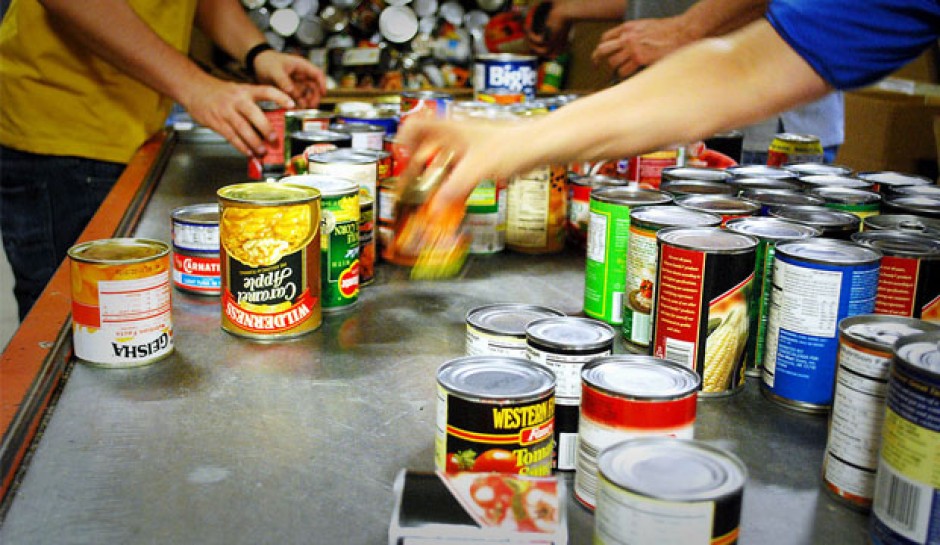
Since April 2013, this borough’s Trussell Trust food banks have given out enough food to provide 35,000 meals. It has fulfilled over 1800 vouchers, which translates to about 2300 adults and 1500 children. Alan’s team has collected nearly 40 tonnes of food and distributed just over 30 tonnes through the eight welcome centres across the borough. The organisation is now fully established, with strong teams in the warehouse and the welcome centres.

Alan adds: ‘All these numbers far exceed our expectation at the beginning of the year. It is not my wish to enter the political debate but I will share with you that the vast majority of people we meet are sincere and their need is genuine. We continue to be grateful to the many churches and schools who have been the chief contributors of food.’ This, he says, has been supported by the permanent collection points facilitated by the local council and by collection points in local Tesco and Sainsbury supermarkets. The challenge continues to gather in sufficient of the less popular food items so that the volunteers can make up complete packs. The local food bank network now has a clever App that provides details of food abundances and shortages, and will help enormously (assuming donors have smartphones etc).

Some people are falling through the safety net, though. They’re very vulnerable indeed, and for a significant number food bank packs are not going to solve their problems. What they need is long-term support and intervention – from a state that’s capable of engaging with them. They deserve welfare policies that offer proper help to individuals struggling with a host of adverse circumstances, including chronic ill health. Not just sanctioning their benefits when they ‘fail’ to apply for enough ‘jobs’, or being left without benefits while they wait in limbo for decisions on employment and support allowance (ESA) to be reconsidered.

Will Peter and Sue get added to this year’s malnutrition statistics?

Is the government rushing to close down the few remaining sources of help for people like Peter and Sue (not their real names), a couple who came into the London food bank last week? Both of them have serious health issues and their sickness benefits have been delayed.

Yesterday, the story broke that the £347m hardship fund, a potential safety net for the couple, is being scrapped. The Local Government Association (LGA) is calling for ministers to review the decision. The LGA says its abolition could leave councils unable to support families who face a crisis. The loss of the Local Welfare Assistance Fund would leave councils having to find money for this from their overall budgets. The government is reported as saying that councils will continue to give support to those in financial difficulties, but the LGA has highlighted that overall funding for local government has been cut by more than 40 per cent over the course of this parliament. Doing away with this fund could leave some areas unable to afford to help out people in crisis.

This development is not going to make life any easier for Peter and Sue, who usually get employment and support allowance (ESA), but had no way of feeding themselves last week. Peter, who is bipolar, had sent the sick note that he hopes would have triggered a renewal of ESA to an office in Ireland, but believes it’s been lost in the post. Before he can start receiving ESA again, he has to repeat the process of getting his key mental health worker to arrange an appointment with his psychiatrist. It’s easy to see that this is all going to take a while to sort. Sue, who is epileptic, had been friends with Peter for many years before they became a couple. They got together after she broke up with her ex-husband, who had been violent towards her. She doesn’t seem to know why her ESA has been delayed.

Both of them have older children from their previous relationships, and now Sue, 36, thinks she may be pregnant. The couple, who are clearly devoted to each other, are living together. Sue receives housing benefit and disability living allowance (DLA) in addition to ESA. With both sets of ESA now on hold, they are trying and failing to survive on Sue’s DLA of £41 a week. That sum has to cover rent, gas, electricity, council tax and food for two. Except of course, it isn’t covering food, which is why they’re here at the food bank.

They’re worried their gas and electricity are about to run out. That would leave them in a cold house, unable to heat up some of the tins of food we’re giving them. Our food bank manager Alan rang their energy supplier Utilita, which calls itself “the UK’s leading prepayment gas and electricity supplier”. He said they weren’t very interested in helping. “The couple had recently switched suppliers and this supplier (Utilita) did not seem to understand its responsibility to help vulnerable people and in any case could not act until their smart meter was installed.”

He added that in stark contrast, he contacted energy provider EDF the same day on behalf of another client, and they quickly agreed to provide an emergency supply of gas and electricity – £20 in each case. A bit of welcome good news. Well done EDF.

Getting help from the state seems to be getting harder and harder. Sue says that when they went to the job centre to use the phones, only one phone was left for clients to use. There used to be six lines available. The pair walked miles from their home to the job centre only to find they were unable to get help.

For Peter and Sue, life is very tough at the moment. Peter says they have both been “hungry the last week or two”. This is a particularly worrying development for someone who may be in the first three months of pregnancy. Life is a daily battle for survival. Peter says the key person who helps them is a local vicar. He’s the one who gave them a voucher for the food bank. “He’s understanding and he looks after us. He hates the government like I do. We are just oiks to them. If we get one less payment then the government saves a bit of money.”

The anger expressed by Peter’s vicar is being writ large across the nation. The open letter published in the Daily Mirror last week signed by 27 Anglican bishops is scathing about the Coalition’s “cutbacks to and failures in the benefit system” that have left half a million people visiting food banks since last Easter. It also says that 5,500 people were admitted to hospital in the UK with malnutrition last year. Peter and Sue are in danger of being included in this year’s malnutrition statistics.

The food bank helps depressed Femi as he recovers from a suicide bid

femifeb2014

As soon as I met Femi (not his real name) at this London food bank, I felt I knew him already. It turned out that as soon as he started talking I realised that I’d met his wife some months ago. Her story is here. Elizabeth (not her real name) came into the food bank for support after her husband had tried to hang himself and had become an inpatient at the local mental health trust.

As soon as he began to tell me that he was from Nigeria, had three young children (aged 8, 6 and 11 months) and started studying accountancy in London before he ran into difficulties, I’d a strong feeling I’d been talking to his wife. The lovely Elizabeth had made a deep impression on me as she described how her family’s life had got so hard. She said she’d just about managed to stop her husband as he had tried to hang himself at home in September, and of how her young daughter (of 8) had to run and get a knife to help cut her husband down in time.

What drove Femi, 34, who came here in 2008 to study, to the brink of suicide? He told me he had been working in banking back in Nigeria and came to England in search of a better life for himself and his family. Initially he arrived on his own to start studying for his ACCA (Association of Chartered Certified Accountants) exams. “The UK was like a dreamland to me. My dad came here in 1975 and he told me many things about it. I lost my mum (in Nigeria) 30 years ago, so I had to grow up very quickly. I left home when I was 12.” When he was growing up in Nigeria he had to spend a lot of time fending for himself. He put much of his own savings into paying for his studies in London, with some support from his father in Nigeria. I also remembered that Elizabeth said her husband had worked when he could while he was studying.

But by 2010, things were getting tough. His wife joined him, but noticed that he was struggling with things like brushing his teeth and keeping clean. “I went to the GP and was diagnosed with depression. I was so ashamed.” He says that there’s a massive stigma in Nigeria about having depression, so he didn’t think he could share his feelings with what remains of his family back in Africa. Despite all, he still managed to pass the exams before he had to leave his course without completing it. “I keep my results on a piece of paper in my pocket, just to remind me of what I’ve done.”

The biggest blow of all came on September 17 last year, when the outcome of his immigration appeal came through. He had spent all his money – and received some financial help from friends – to fund an appeal on health grounds against the decision by the Home Office to refuse his immigration application. The process cost £3,000, to include the costs of the tribunal, £1,400 to the Home Office and £1,340 to the solicitor who took on his case. The news was the trigger for the already depressed Femi to carry out his suicide attempt. “I tried to commit suicide in the middle of the night. My daughter saw me.”

Femi sees the judge’s appeal decision as deeply unfair: “The judge said I should not be treated here. I said that I did not come here with depression. I worked in banking before I came to England. I took the UK as my home.” He even managed to donate £15 to charity every month for a while when he was working. He now has no money to fall back on, and he and his family are facing eviction from his privately-rented house.

He has nothing but praise for the social worker involved with the family, and he’s also receiving intensive treatment three days a week from the local mental health trust. The family has had some emergency payments from the council (which I’ve noticed tries so much harder than the other council on our doorstep to help the vulnerable when it can), but the money has to cover everything and there’s not often enough to buy adequate food. There have been times when the children didn’t have anything to eat. So the social worker has given the family the occasional voucher for the food bank. The family really needs this extra support, but the food bank can’t ever be more than a stop gap to cover an immediate crisis.

The couple only realised recently that Elizabeth is pregnant again – she had been taking contraceptives so this came as a great shock – with the new baby due in May. Femi is once again appealing the decision to refuse his immigration application on health grounds, and the hearing is due at the end of this month. The council is looking at how the family might be rehoused, but of course there are no guarantees of anything. He’s still crying every day, he tells me…

He went home last night with some food for his children, and that, at least is a small comfort.

Wish him well.